Views: 0 Author: Site Editor Publish Time: 14-10-2026 Origin: Site
Better machines alone do not guarantee better plywood. Production quality depends on how well each manufacturing stage works together. Traditional plywood production requires extensive manual handling and constant operator attention. Uneven veneer thickness, inconsistent drying, and adhesive waste can increase costs and cause pressing defects. Modern plywood making machine technology helps address these challenges through automation, precise controls, and improved material handling. These advancements support consistent panel quality while reducing labor requirements and production losses. Understanding these technologies helps manufacturers identify practical improvements in veneer processing, gluing, pressing, and quality control. It also helps them choose equipment upgrades that improve efficiency and control operating costs.
Automation has become an important part of modern plywood manufacturing. It helps factories reduce repetitive manual work while maintaining more consistent production conditions. Traditional operations often require workers to move materials between separate machines. These movements take time and may cause delays or damage. Automated equipment can make material handling faster and more predictable. However, automation does not mean every machine must operate independently of workers. The goal is to improve coordination while keeping operators responsible for process quality.
Modern production lines use automated equipment to move veneers between processing stages. Log loaders, veneer stackers, and conveyors can reduce repetitive material handling. For example, an automatic veneer stacker collects peeled sheets after the rotary peeling process. It arranges them into stacks for later drying or processing. This reduces manual sorting and helps maintain a steady workflow.
Automated loading systems also improve operations around plywood presses. They position assembled panels before pressing and assist their removal afterward. These systems can reduce handling delays and improve workplace safety. However, production line integration requires careful capacity planning. A fast peeling machine offers limited benefits when the dryer cannot process its output. Manufacturers should balance equipment speeds before increasing automation.
Programmable logic controllers, commonly called PLCs, help coordinate machine operations. They control programmed sequences using information received from sensors and equipment. Depending on the machine, operators may adjust speed, temperature, positioning, or operating cycles. These settings help maintain consistent processing conditions during production.
Modern control systems may also display operating conditions through digital interfaces. Workers can monitor equipment status and identify certain problems without inspecting every machine manually. However, basic PLC control differs from advanced factory-wide monitoring. Some machines operate through independent controllers, while others exchange production data. Manufacturers should confirm these capabilities before purchasing automated equipment.
Veneer quality directly affects the performance of finished plywood panels. Uneven thickness and uncontrolled moisture can create problems during later manufacturing stages. Modern peeling and drying technologies help manufacturers maintain more consistent veneer properties. They also improve material utilization and reduce avoidable processing losses.
Rotary peeling machines convert logs into continuous sheets of wood veneer. Modern equipment uses improved feeding mechanisms and cutting controls to maintain consistent thickness. Some systems employ precise positioning mechanisms to control the distance between cutting components. This helps operators achieve more uniform veneer sheets during peeling.
Spindleless rotary peeling machines provide another option for suitable log-processing applications. They support log rotation without traditional spindle gripping arrangements. This can help manufacturers process smaller remaining log cores.
Precise peeling offers several practical benefits:
Improved thickness consistency: Uniform veneers support more predictable panel thickness and adhesive application.
Better wood utilization: Controlled cutting can reduce avoidable material losses during processing.
Reduced downstream defects: Consistent veneer sheets simplify stacking, gluing, and pressing operations.
However, machine precision alone cannot guarantee high-quality veneers. Knife sharpness, wood species, log condition, and operator settings remain important. Manufacturers should regularly inspect cutting tools and monitor veneer thickness. These practices help maintain consistent performance throughout production.
Freshly peeled veneers usually contain more moisture than plywood bonding processes require. Drying removes excess moisture before adhesive application and pressing. Modern veneer dryers use controlled heating and airflow to improve moisture consistency. Conveyor speed also affects how long veneers remain inside the drying equipment.
Two common dryer configurations serve different production requirements. Roller dryers transport veneers through heated chambers using rotating rollers. They work particularly well for suitable veneer sizes and automated processing arrangements. Mesh belt dryers support veneers on a moving mesh conveyor. Their design can accommodate different veneer conditions and processing requirements.
Both configurations require suitable temperature, airflow, and transport settings. Poor adjustments may produce uneven drying or increase energy consumption. Excessive moisture can interfere with adhesive performance during pressing. Overdrying may increase energy use and create additional handling problems. Manufacturers should therefore measure veneer moisture rather than rely only on drying time. Appropriate targets depend on wood species, adhesive systems, and production requirements.
Summary: How Modern Veneer Technologies Improve Production
Technology | Main Improvement | Production Impact |
Precision veneer peeling | More consistent veneer thickness | Better material utilization and panel uniformity |
Automated veneer handling | Reduced manual movement | More stable production flow |
Controlled veneer drying | More uniform moisture content | Fewer bonding and dimensional defects |
Improved airflow management | More consistent heat transfer | Better drying efficiency |
These improvements work best when manufacturers coordinate peeling accuracy and drying capacity. Consistent veneer preparation also makes later pressing operations easier to control.
After veneer preparation, manufacturers assemble and bond individual sheets into plywood panels. Adhesive distribution and pressing conditions strongly influence finished panel performance. Modern equipment improves control over these critical manufacturing stages. It helps reduce unnecessary material consumption and supports more consistent bonding.
Traditional glue spreading may produce inconsistent adhesive distribution when equipment settings are poorly controlled. Excess adhesive increases material costs, while insufficient coverage can weaken bonding. Modern glue spreaders use adjustable rollers and improved application controls. Some systems include pneumatic mechanisms that help maintain stable operating conditions.
These improvements allow manufacturers to apply adhesive more consistently across veneer surfaces. The required application amount still depends on adhesive properties and manufacturing specifications. Veneer assembly technology has also improved. Core composing machines help connect suitable veneer pieces into larger sheets. Patching equipment can repair selected defects before panel assembly.
These technologies help manufacturers use available veneer materials more effectively. They also support better layer alignment during subsequent pressing. However, automated application cannot correct unsuitable adhesive selection or severely damaged veneers. Operators must still check adhesive preparation, veneer condition, and assembly quality.
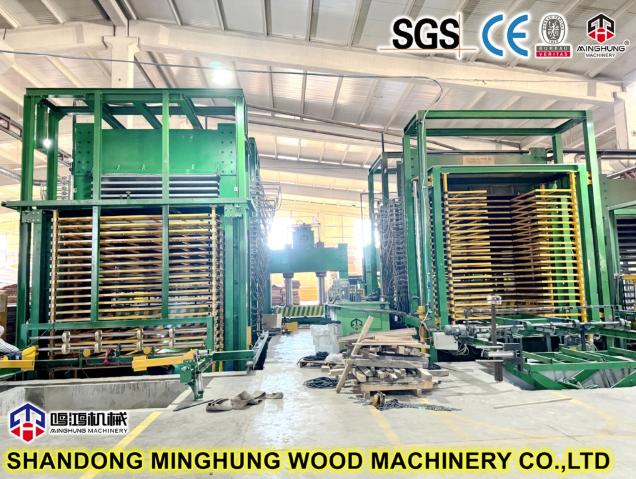
Hot pressing combines heat and pressure to cure adhesive between veneer layers. This stage strongly influences bonding quality, panel thickness, and dimensional stability. Modern hydraulic presses offer improved control over pressure and pressing sequences. Temperature regulation systems help maintain suitable heating conditions during production.
Multi-opening hot presses allow several assembled panels to undergo pressing simultaneously. Their configuration depends on panel dimensions, thickness, and intended production capacity. Automated loading and unloading systems can reduce handling time between pressing cycles. They also help position panels consistently inside the press.
However, shorter pressing cycles do not automatically produce better results. Adhesive curing requirements and veneer moisture still determine suitable pressing conditions. For example, insufficient pressing time may prevent complete adhesive curing. Excessive heat or unsuitable pressure can also damage panels. Manufacturers should therefore select press settings through validated production procedures.
Modern plywood factories increasingly rely on production data to maintain quality. Instead of inspecting only finished panels, they can monitor important conditions throughout manufacturing. Digital systems help operators identify certain processing problems earlier. However, monitoring technology works best alongside regular inspections and established quality procedures.
Sensors help operators observe operating conditions across individual production machines. They may measure temperature, pressure, moisture, or equipment status. For example, temperature sensors can detect unexpected changes inside veneer dryers. Pressure monitoring can identify deviations during hydraulic press operation.
When equipment includes suitable recording functions, managers can compare operating conditions across production shifts. This helps them investigate recurring problems and improve process settings. Advanced monitoring systems may also support condition-based maintenance. They identify changes in equipment behavior before some failures become serious.
However, predictive maintenance requires reliable historical data and appropriate analysis. Installing sensors alone does not create a fully predictive system. Factories should begin by monitoring variables closely connected to their quality problems.
Automated inspection technologies can help manufacturers identify selected panel defects. These systems may include cameras, thickness measurement devices, or other sensors. Depending on their configuration, they can detect surface irregularities or dimensional variations. This reduces reliance on manual observation for repetitive inspection tasks.
However, visible inspection cannot confirm every plywood performance requirement. Bonding strength and other internal properties may require destructive laboratory testing. Manufacturers should combine automated measurements with established testing procedures. This provides a more complete understanding of finished panel quality. Recorded inspection results can also reveal recurring production patterns. For example, repeated thickness variation may indicate pressing or sanding problems.
Plywood manufacturing consumes energy during drying, pressing, and material processing. It also produces waste through trimming, rejected veneers, and defective panels. Modern equipment can reduce these losses through improved operating control. However, actual savings depend on factory conditions and production management.
Veneer drying and hot pressing are important areas for energy management. Both processes require controlled heating to achieve suitable manufacturing conditions. Improved dryer insulation can reduce unwanted heat losses. Better airflow distribution helps maintain more consistent drying across veneer sheets.
Modern heating controls can also reduce unnecessary temperature fluctuations. They help equipment maintain appropriate operating conditions during production. In hot pressing, operators should coordinate heating requirements and production schedules. Long interruptions can waste energy when equipment remains at operating temperature.
However, lowering temperatures without considering process requirements may create quality problems. Energy efficiency must never compromise adhesive curing or veneer preparation. Manufacturers should compare energy consumption against actual production output. This provides a more useful measurement than total energy consumption alone.
Wood recovery is another important measure of production efficiency. Poor peeling accuracy can create unnecessary thickness variation and unusable material. Modern peeling controls help manufacturers produce more consistent veneer sheets. This can increase the proportion of materials suitable for production.
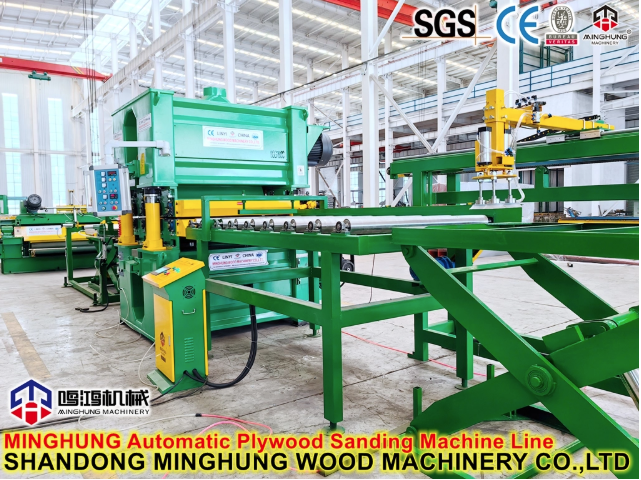
Core composing and veneer patching equipment provide additional recovery opportunities. They allow manufacturers to process suitable smaller veneer pieces rather than discard them. Accurate edge trimming also helps reduce unnecessary material removal. Proper sanding control prevents excessive thickness reduction during finishing.
Manufacturers should track several operating indicators:
Veneer recovery rate: The proportion of usable veneer obtained from processed logs.
Panel rejection rate: The percentage of finished panels failing quality requirements.
Adhesive consumption: The quantity used for a defined production output.
Rework volume: The number of panels requiring additional processing.
These measurements help factories identify where material losses occur. They also provide evidence for evaluating future equipment upgrades.
Advanced machinery offers potential benefits, but not every factory needs complete automation. The most suitable investment depends on existing equipment and production problems. Manufacturers should examine measurable operating conditions before selecting new machinery. This approach reduces unnecessary spending and improves equipment compatibility.
A production bottleneck limits the output of an entire manufacturing line. It may occur during peeling, drying, assembly, or pressing. For example, a factory may produce veneers faster than its dryer can process them. Installing a faster peeling machine would not solve this limitation.
Manufacturers should compare operating capacity across each production stage. They should also review labor requirements, downtime, material losses, and product defects. An individual plywood making machine upgrade may solve a specific problem. Other factories may benefit more from coordinated improvements across several stages.
Equipment specifications should also match actual manufacturing requirements. Important considerations include wood species, panel dimensions, adhesive systems, and production targets.
Manufacturers should evaluate machinery investments using realistic performance expectations. Higher advertised production capacity does not always guarantee higher factory output. Useful indicators include output per shift, material recovery, energy consumption, and equipment downtime. These measurements help establish performance before and after upgrades.
Investment costs should include installation, operator training, maintenance, and spare parts. Factories should also consider production interruptions during equipment replacement.
Before purchasing, manufacturers can use this practical evaluation checklist:
1. Identify the main bottleneck. Determine which process limits output or creates the greatest losses.
2. Record current performance. Measure production capacity, rejection rates, and resource consumption.
3. Check equipment compatibility. Confirm dimensions, operating requirements, and connections between machines.
4. Estimate operating improvements. Compare realistic output, quality, and efficiency expectations.
5. Review support requirements. Evaluate training, maintenance access, and spare parts availability.
6. Calculate investment payback. Compare expected savings against total implementation costs.
Manufacturers should request technical specifications before making purchasing decisions. Equipment demonstrations can also help verify important operating capabilities. A successful upgrade should solve a clearly identified production problem. It should also deliver improvements that the factory can measure.
Technological advancements in plywood production help manufacturers improve product consistency, reduce material waste, and overcome production bottlenecks. Precision veneer peeling, controlled drying, automated handling, and reliable pressing each contribute to greater manufacturing efficiency. However, manufacturers should select technologies based on actual production needs rather than automation alone. Equipment compatibility, operating costs, and measurable improvements remain essential considerations. At Shandong MINGHUNG OSB&MDF Machinery Equipment Manufacturing Co., Ltd., we provide plywood making machine solutions covering veneer preparation, gluing, and pressing. Our configurable equipment helps manufacturers improve production efficiency and maintain consistent panel quality. We also support customers in selecting machinery suited to their production requirements.
A: Modern plywood making machine technology includes automated veneer handling, PLC controls, precision peeling, and advanced pressing systems. These improvements help manufacturers maintain consistent quality, reduce manual labor, and improve production efficiency.
A: An automated plywood making machine reduces manual handling and improves processing consistency. Automated material transfer and coordinated equipment controls help minimize production delays, reduce labor requirements, and maintain steady output.
A: Precise veneer moisture control supports stronger adhesive bonding and consistent panel quality. Modern veneer drying technology regulates temperature, airflow, and conveyor speed to reduce uneven drying and potential pressing defects.
A: Advanced plywood hot press machines provide better control over temperature, pressure, and pressing cycles. These improvements support consistent adhesive curing, reduce thickness variation, and minimize bonding defects during production.
A: Before upgrading a plywood making machine, manufacturers should examine veneer thickness, moisture levels, press performance, and equipment downtime. These measurements help identify bottlenecks and prioritize effective technology improvements.


