Views: 126 Author: Site Editor Publish Time: 28-01-2026 Origin: Site
In the rapidly evolving world of industrial furniture manufacturing and construction, the selection of core materials dictates the durability, cost-effectiveness, and aesthetic potential of the final product. As global timber resources become more scrutinized, engineered wood products have filled the void, providing sustainable alternatives to solid wood. For B2B buyers and factory owners, understanding the nuances between Medium-Density Fiberboard (MDF) and Particleboard (also known as chipboard) is critical when investing in a high-capacity chipboard production line or seeking to optimize a particleboard production line.
MDF and Particleboard are both engineered wood products made from wood residuals bonded with resin under heat and pressure, but they differ significantly in density and composition: MDF is made from extremely fine wood fibers resulting in a smooth, dense surface, while Particleboard is made from larger wood chips and shavings, making it a more cost-effective, lightweight structural material produced by a standard chipboard production line.
Choosing between these two materials involves more than just a price comparison; it requires a deep dive into the mechanical properties and the specific machinery required for their creation. Whether you are looking to purchase a particle board production line or simply sourcing panels for a large-scale project, this guide will provide the technical depth needed to distinguish these materials and understand the role of a modern chipboard making machine in the current market.
MDF, or Medium-Density Fiberboard, is an engineered wood product created by breaking down hardwood or softwood residuals into fine wood fibers, combining them with wax and a resin binder, and forming panels by applying high temperature and pressure within a specialized production environment.
The manufacturing process for MDF is distinct from a traditional particleboard production line. While a chipboard production line utilizes larger chips, MDF requires the wood to be "defibrated." This means the raw wood material is steamed and then physically rubbed apart into individual fibers. These tiny fibers create a board that is incredibly consistent throughout its entire cross-section. Because the fibers are so small, the resulting board has no visible grain and a surface that is as smooth as paper, making it the premier choice for high-end painted finishes or intricate routing.
In a professional setting, the density of MDF typically ranges between 600 kg/m³ and 800 kg/m³. Because of this high density, MDF is significantly heavier than the output of a standard particle board production line. This weight is a byproduct of the intense pressure used in the particleboard making machine during the curing process. The lack of voids or air pockets within the board allows for precision machining; you can cut detailed profiles into the edges of MDF without the material crumbling, a feat that is impossible with standard chipboard.
Furthermore, MDF serves as an excellent substrate for veneers and laminates. In many large-scale furniture factories, an MDF line runs parallel to a chipboard production line to offer a tiered product range. While the chipboard making machine handles the structural carcasses of cabinets, the MDF line produces the decorative doors and finished panels. This synergy allows manufacturers to maximize their raw material usage while meeting diverse market demands for both durability and aesthetic flexibility.
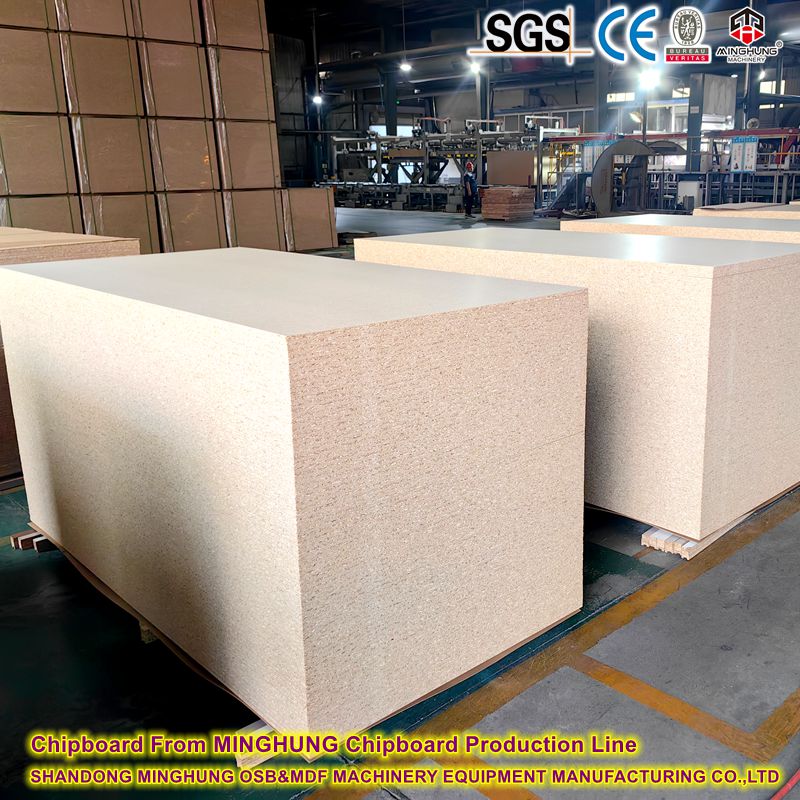
Particleboard, frequently called chipboard, is a waste-wood product manufactured from wood chips, sawmill shavings, or even sawdust, which are glued together with resin and pressed into sheets through a high-efficiency chipboard production line.
The heart of particleboard manufacturing lies in the particleboard production line. Unlike MDF, which focuses on fibers, a chipboard making machine is designed to handle various sizes of wood particles. Modern boards are often "three-layered," where the core consists of larger, coarser chips for structural strength, while the two outer layers consist of finer particles to provide a smoother surface for lamination. This layered structure is a primary focus for any company looking to optimize their particle board production line for better surface quality.
One of the greatest strengths of the particleboard making machine is its ability to utilize recycled materials. By taking the "waste" from other timber processes, a chipboard production line converts low-value scraps into a high-value construction material. This makes particleboard the most cost-effective engineered wood on the market. It is the primary material used in flat-pack furniture, office desks, and kitchen carcasses globally. Its lower density compared to MDF also makes it easier to transport and handle on a large scale.
Technically, particleboard is appreciated for its dimensional stability. While solid wood expands and contracts with humidity, the random orientation of chips within a board produced by a particleboard production line prevents significant warping. However, because it is composed of larger chips, it is more porous than MDF. This means that the edges must be sealed with edge-banding to prevent moisture ingress and to provide a finished look. For B2B manufacturers, the throughput of a chipboard making machine is often higher than that of MDF, allowing for massive production volumes to satisfy global retail chains.
The primary advantages of these materials include exceptional cost-efficiency for Particleboard and superior finishing capabilities for MDF, both of which are made possible by the precision of a modern particleboard production line or fiberboard system.
When analyzing the benefits of a chipboard production line, the focus is almost always on the bottom line. Particleboard is significantly cheaper to produce than MDF or plywood. For B2B buyers, this translates to higher margins on mass-produced items. Additionally, particleboard is lightweight, which reduces shipping costs for RTA (Ready-to-Assemble) furniture. A high-quality particle board production line can also produce boards with enhanced properties, such as moisture resistance or fire retardancy, by adding specific chemicals during the resin-mixing stage in the chipboard making machine.
| Feature | Particleboard (Chipboard) | MDF (Fiberboard) |
| Primary Advantage | Cost-Effectiveness | Surface Smoothness |
| Material Source | Wood chips & shavings | Fine wood fibers |
| Production Line | Chipboard production line | Fiberboard press line |
| Best Use | Cabinet carcasses, flooring | Decorative doors, molding |
| Machinability | Limited to straight cuts | Excellent for routing/carving |
MDF's advantages lie in its versatility and premium feel. Because it is denser, it holds screws better in some applications and provides a much more stable base for high-gloss lacquers. While a chipboard making machine produces a board that might show "telegraphing" (where the texture of the chips shows through a thin veneer), MDF remains perfectly flat. This makes it the preferred material for architectural moldings, wainscoting, and high-end cabinetry.
Furthermore, both materials represent a win for environmental sustainability. Every particleboard making machine operating today is essentially a recycling unit, turning what would be landfill waste into functional products. The efficiency of a particleboard production line ensures that nearly 100% of the wood fiber entered into the system ends up in the final board, minimizing waste and maximizing the utility of every harvested tree.
The fundamental differences between MDF and Particleboard lie in their internal composition, surface density, and mechanical strength, factors that are determined by whether the factory utilizes a chipboard production line or an MDF fiber-processing system.
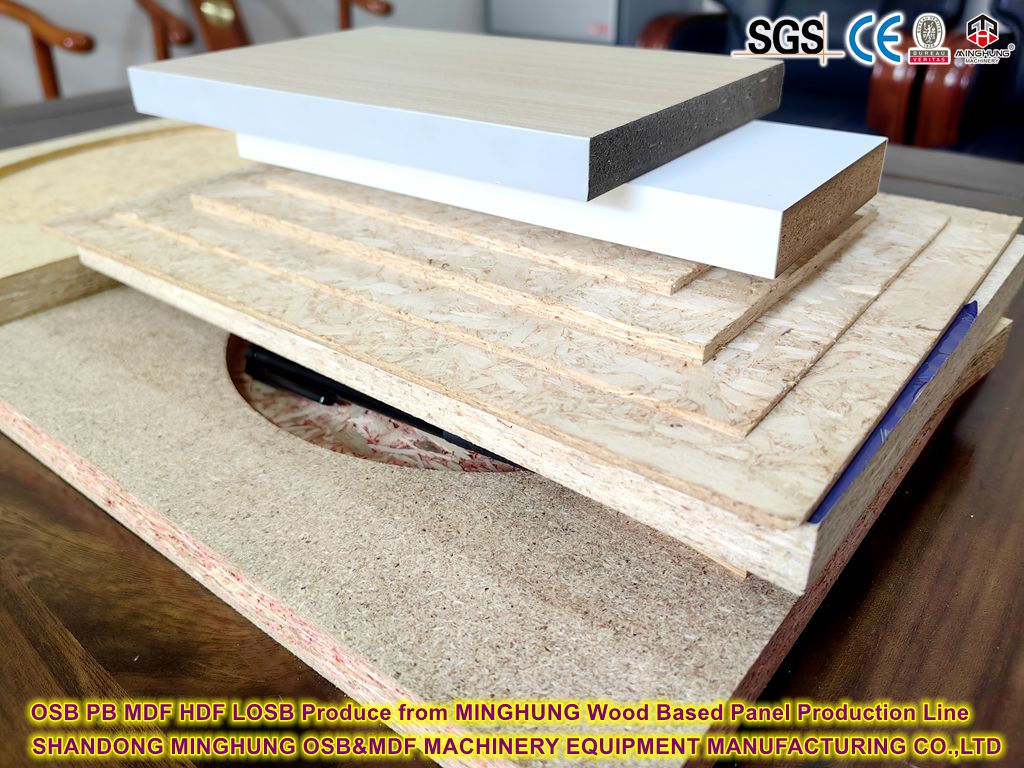
The most visible difference is the texture of the edges. If you cut a board from a chipboard making machine, you will see distinct wood chips and small voids. If you cut a piece of MDF, the edge appears solid and uniform, almost like thick cardboard. This structural difference is why a particleboard production line is generally used for furniture that will be "boxed in," while MDF is used for parts that require decorative shaping. The fine fibers of MDF allow for smooth, curved edges, whereas the coarse chips in a chipboard production line would break or crumble if routed.
From a strength perspective, MDF generally has higher longitudinal strength and screw-holding capacity in the face of the board. However, particleboard produced on a high-end particle board production line is often preferred for large, flat horizontal surfaces like shelving because it is less prone to sagging over long spans compared to some lower-grade MDFs. The "internal bond" strength—a key metric for any chipboard production line—measures how well the particles stay together under tension, and modern resins have made particleboard incredibly competitive in this area.
Moisture reaction is another key differentiator. Standard products from both a chipboard making machine and an MDF line are susceptible to swelling if they get wet. However, particleboard tends to swell more "locally" at the edges, while MDF may expand across the entire thickness of the panel. For B2B applications in kitchens or bathrooms, both production lines must be adjusted to use MR (Moisture Resistant) resins, ensuring the particleboard production line outputs a P5 grade board suitable for humid environments.
MDF
chipboard
A chipboard production line remains the backbone of the global furniture industry, providing the affordable, stable, and sustainable panels required for mass consumption. Meanwhile, MDF continues to be the darling of designers and high-end manufacturers who require a smooth, machinable surface. By understanding the mechanical differences and the capabilities of a modern particleboard making machine, B2B professionals can better align their material sourcing with their production goals.