Views: 0 Author: Site Editor Publish Time: 03-06-2026 Origin: Site
In the fast-evolving landscape of global furniture manufacturing and interior construction, engineered wood products have fundamentally altered how we approach interior design and structural utility. As industries strive for both economic efficiency and sustainable raw material usage, particle board has emerged as a dominant material choice. It provides a standardized, versatile, and cost-effective alternative to solid lumber, serving as the essential substrate for everything from residential cabinetry to complex office furniture systems.
Particle board, also widely known as chipboard, is an engineered wood composite panel manufactured by binding small wood particles, sawdust, or wood shavings with synthetic resin adhesives under intense heat and pressure, resulting in a dense, uniform board used extensively in modern furniture production.
Section | Summary |
Defining Particle Board | An overview of what particle board is, its composition, and its primary role in the furniture industry. |
The Industrial Manufacturing Process | A detailed breakdown of the steps from raw material chipping to the final pressed panel. |
Key Raw Materials and Binding Agents | Analysis of the wood components and synthetic resins used to ensure structural integrity. |
Applications and Industry Advantages | A look at why particle board remains a preferred material for diverse interior applications. |
Particle board is a composite wood panel made from wood waste—such as sawmill shavings, chips, and sawdust—which are combined with resin to form a versatile, isotropic building material.
At its most fundamental level, particle board is designed to provide consistency that natural wood cannot offer. While solid timber possesses grains and knots that can lead to unpredictable warping, shrinking, or splitting, particle board is engineered to be structurally uniform. This makes it an ideal substrate for lamination, wood veneer application, and decorative finishings. Because the material is isotropic, it performs reliably across all directions, allowing for precise milling and drilling during the assembly of modular furniture.
The evolution of this material has been closely tied to advancements in a high-efficiency chipboard production line. Modern facilities can now tailor the board's density according to the intended application. For instance, high-density variants are engineered to have superior screw-holding capabilities, whereas lighter-density versions are utilized where weight reduction is a priority.
Furthermore, particle board represents a cornerstone of the circular economy within the wood industry. By transforming byproduct material from logging and sawmilling into valuable panels, manufacturers significantly reduce waste. This process not only provides a cost-effective solution for furniture makers but also aligns with global sustainability initiatives, ensuring that wood resources are maximized for the greatest industrial utility.
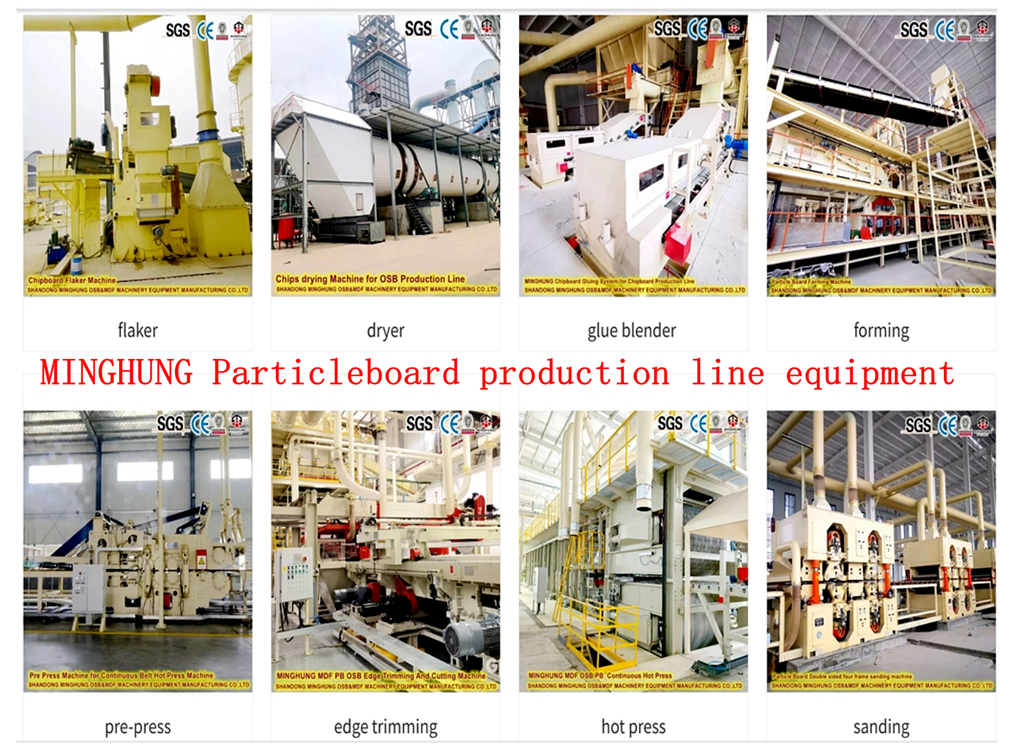
The manufacturing of particle board involves a multi-stage industrial sequence that includes wood chipping, drying, particle grading, resin blending, mat forming, and high-temperature compression.
The process begins with the preparation of raw materials, where wood waste is reduced into chips of uniform size. These chips are then dried to a specific moisture content to ensure optimal bonding during the subsequent resin application. Once dried, the wood particles are categorized; typically, finer particles are directed toward the surface layers of the panel to ensure a smooth finish, while larger, coarser chips are used for the core to provide structural strength. For a more detailed look at the technical stages involved, readers may consult this guide to particle board production and applications.
Following the grading process, the particles are blended with synthetic resin adhesives. The mixture is then spread out into a continuous mat on a conveyor system. This mat is subjected to extreme heat and pressure in a continuous press, which activates the resin and binds the particles into a solid, durable board. The efficiency of a particle board manufacturing line is determined by its ability to maintain consistent heat distribution and pressure throughout this stage, ensuring that every panel meets strict quality benchmarks.
Once the boards exit the press, they are cooled, cut to size, and sanded to achieve the required thickness. Sanding is an essential step that prepares the surface for the final lamination phase. Throughout this entire sequence, automated sensors monitor real-time data, allowing operators to adjust parameters instantly to maintain uniformity across thousands of panels per day.
The structural integrity of particle board is derived from the precise combination of lignocellulosic wood particles and specialized synthetic resins such as urea-formaldehyde or melamine-based adhesives.
The quality of the final panel depends heavily on the chemical composition of the bonding agents. These resins are chosen based on the desired performance characteristics of the board. For example, furniture intended for kitchens or high-humidity environments requires moisture-resistant resins, often supplemented with wax emulsions to minimize water absorption. These additives are critical in preventing swelling and maintaining the longevity of the furniture in varied residential settings.
The wood particles themselves can range from industrial residues to recycled wood materials. In an advanced chipboard production line, the preparation of these particles is highly controlled. The ratio of particles to resin must be calibrated with extreme precision; too little resin results in poor internal bond strength, while too much increases production costs and may affect the final density of the board.
Industry standards also dictate the emissions profiles of these resins. As environmental regulations become stricter, the shift toward low-emission resins has become a primary focus for producers. Manufacturers now utilize sophisticated blending technology to ensure that the chemical components are distributed evenly throughout the core, guaranteeing that the board complies with international indoor air quality standards without compromising the structural performance required by modern furniture standards.
Particle board is favored across the furniture and construction industries for its superior cost-to-performance ratio, ease of machining, and ability to accept a wide variety of aesthetic finishes.
The ubiquity of this material is a testament to its advantages. From modular shelving to heavy-duty office desks, particle board provides the structural skeleton for many of the products used in our daily lives. Its primary industrial advantages include:
Economic Efficiency: By utilizing wood byproducts, the cost of the raw material is significantly lower than natural timber, allowing for the mass production of affordable furniture.
Processing Versatility: Because of its uniform density, it can be easily cut, routed, and edge-banded using standard industrial woodworking machinery.
Wide Variety of Surface Options: The surface can be covered in melamine paper, wood veneer, or high-pressure laminates, providing a high-end look at a fraction of the cost of solid wood furniture.
Whether for home decor or commercial interior fit-outs, particle board stands as a reliable, high-performance material that continues to drive innovation in design. As manufacturing technologies continue to advance, the efficiency and sustainability of these panels will only increase, cementing their place as a foundational element of the global furniture industry.
Our contacts:
Whatsapp: +8618769900191 +8615589105786 +8618954906501
Email: osbmdfmachinery@gmail.com