Views: 0 Author: Site Editor Publish Time: 12-11-2026 Origin: Site
Chipboard is found in countless furniture pieces, yet its manufacturing process is often overlooked. It offers an affordable alternative to solid wood for many indoor applications.
Also called particleboard, chipboard combines wood particles and adhesives under heat and pressure. Unlike paper-based chipboard, it forms rigid panels used in cabinets, furniture, and interior construction. Industrial production involves several stages, from preparing wood particles to finishing the boards. A Chipboard Making Machine production line connects these processes to support consistent panel quality. Understanding each stage helps explain how chipboard gets its strength, smooth surface, and practical uses.
Chipboard production begins with suitable wood particles and bonding materials. Their properties directly affect panel strength, surface quality, and manufacturing efficiency. Manufacturers must consider particle size, moisture content, adhesive compatibility, and material cleanliness before production begins.
Wood particles form the main structure of chipboard. They commonly come from sawmills, woodworking factories, and other wood-processing operations. Using suitable residues helps manufacturers convert leftover materials into useful panels.
Common raw materials include:
Wood chips: Produced from logs, branches, and larger wood pieces.
Sawdust: Fine particles generated during wood cutting and machining.
Wood shavings: Thin particles collected from planing and woodworking operations.
Recycled wood: Suitable recovered wood materials processed after contamination checks.
Particle dimensions influence how the board forms during pressing. Fine particles typically create smoother outer surfaces, while larger particles form the inner core. This layered structure supports consistent panel properties and makes surface finishing easier.
However, recycled wood requires careful inspection before entering production. Metal, plastic, coatings, and other contaminants can damage equipment or affect board quality. Manufacturers therefore use sorting, screening, and suitable cleaning equipment to prepare their materials.
Wood particles cannot form a stable board through compression alone. They need adhesives to create lasting bonds during hot pressing. Urea-formaldehyde resin, commonly called UF, is widely used for general-purpose interior particleboard. Phenol-formaldehyde resin, or PF, offers different bonding properties for suitable applications. Polymeric methylene diphenyl diisocyanate, known as pMDI, provides another adhesive option. These adhesives require different processing conditions and safety controls.
Manufacturers select them according to board specifications, application requirements, and relevant emission regulations. Additional materials can also improve particular properties. For example, wax emulsions help reduce water absorption under suitable conditions. Other additives may support specialized fire-performance or moisture-resistance requirements. The correct adhesive quantity is equally important. Too little adhesive can weaken internal bonding and increase the risk of separation. Excessive application increases material costs without necessarily improving panel performance.
Industrial chipboard manufacturing follows a connected sequence of mechanical and thermal processes. Each stage prepares the material for the next operation. The goal is to produce consistent panels that meet their intended specifications.

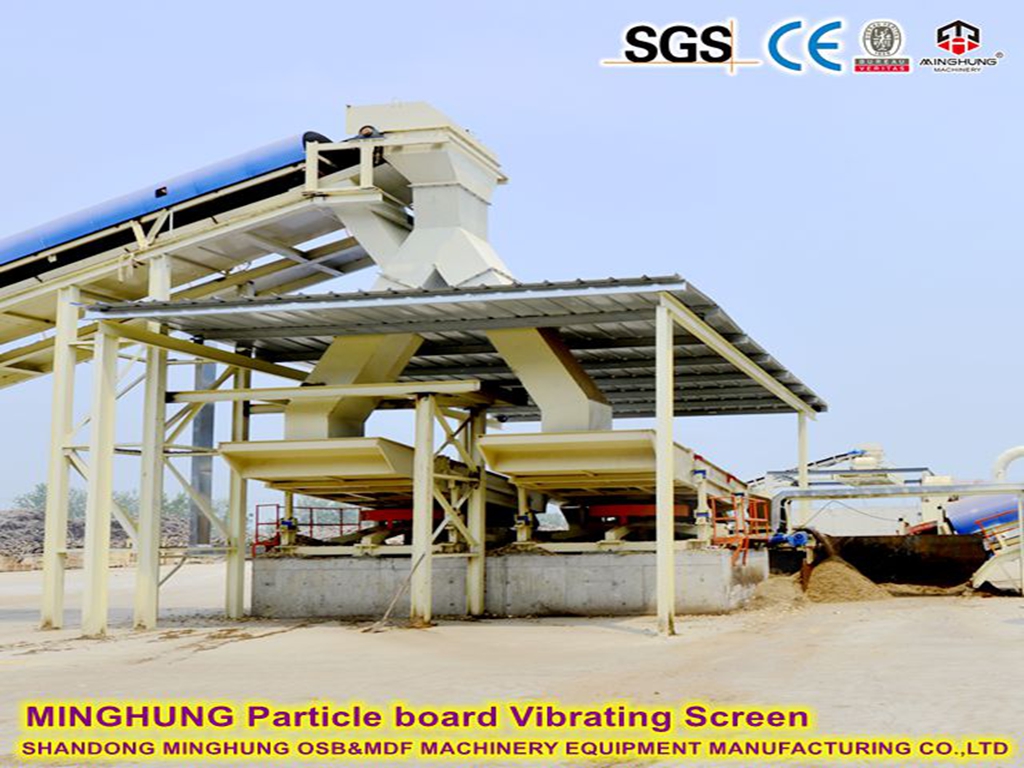
Manufacturing begins by collecting and preparing suitable wood materials. Operators remove unsuitable debris before feeding larger pieces into particle-preparation equipment. Wood chippers and other size-reduction machines process these materials into smaller particles. Their dimensions must match the production requirements for the intended board structure. The particles then pass through vibrating screens or other classification equipment. These systems separate different particle sizes and remove unsuitable material. Fine particles generally serve the outer layers, while coarser particles form the core.
After screening, particles enter a drying system. Rotary drum dryers are commonly used in industrial particleboard production. Drying reduces excess moisture before adhesive application and pressing. However, the required moisture content varies by particle type and adhesive system. Excessive moisture can create steam-related pressing problems and weaken bonding. Overdrying can also affect processing behavior and increase energy consumption. Reliable moisture control therefore helps maintain stable production conditions.
chipboard vibrating screen
minghung pb drying machine
Once the particles reach suitable moisture conditions, they enter the adhesive application system. Resin is distributed across their surfaces through controlled spraying and mixing. The objective is to achieve adequate adhesive coverage without unnecessary resin consumption. Uneven application can create weak areas inside the finished panel. Next, the blended particles enter a forming machine. It distributes them into a loose mat according to the required board dimensions.
Many conventional particleboards use a three-layer arrangement:
Upper face layer: Fine particles create a relatively smooth surface.
Core layer: Coarser particles provide the main internal structure.
Lower face layer: Fine particles complete the balanced layered arrangement.
This structure helps manufacturers achieve suitable surface and mechanical properties. The exact layer arrangement depends on the intended panel grade. Mat formation also requires consistent material distribution across the production width. Uneven distribution can cause differences in density, thickness, and strength. Operators monitor the forming process to maintain the required mat weight and profile. A uniform mat provides a more stable starting point for pressing.
gluing system for chipboard
MINGHUNG chipboard forming machine
The formed mat is initially loose and difficult to handle. Pre-pressing compresses it into a more stable structure before final pressing. This operation reduces mat thickness and improves its handling during transfer. It also helps prepare the material for the next compression stage. The pre-pressed mat then enters a hot press. Heat and pressure consolidate the wood particles while curing the adhesive. During pressing, several important changes occur. The particles move closer together, while the adhesive develops bonding strength. The board gradually reaches its required thickness and density profile.
Pressing conditions depend on several factors:
Temperature: Supports adhesive curing under the selected production conditions.
Pressure: Compresses the mat and helps establish the required panel thickness.
Pressing time: Allows sufficient heating and adhesive curing throughout the board.
Mat moisture: Influences heat transfer, steam generation, and pressing behavior.
The exact settings depend on board thickness, adhesive chemistry, and press design. Manufacturers must balance these conditions to avoid weak bonding or internal defects. Insufficient pressing can produce poorly bonded panels. Incorrect moisture or pressing conditions may also cause blistering or internal separation.
pre press machine
continuous hot press
After hot pressing, the boards leave the press at elevated temperatures. They require cooling and suitable conditioning before further processing. Cooling helps stabilize the panels and prepare them for finishing operations. The boards then pass through trimming equipment to remove uneven edges.
Sanding machines process the surfaces to achieve the required thickness and smoothness. This operation is particularly important for panels receiving decorative laminates or veneers. Finished boards undergo inspection before packaging or further processing. Typical checks include dimensions, density, surface condition, and bonding performance. Panels that fail the required specifications may need reclassification or rejection. Effective inspection helps prevent unsuitable materials from reaching customers.
edge cutting sawing machine
particleboard sanding machine
Producing chipboard at an industrial scale requires several connected equipment systems. A complete line supports material preparation, pressing, finishing, and internal transportation. The equipment must operate together to maintain consistent output and board quality.
A typical Chipboard Making Machine production line contains several specialized machines. Each system performs a distinct operation within the manufacturing process.
The main equipment includes:
Wood preparation machines: Reduce larger wood materials into suitable particles.
Vibrating screens: Classify particles according to size.
Drum dryers: Remove excess moisture before resin application.
Resin application systems: Distribute adhesives across prepared particles.
Forming machines: Arrange particles into mats with controlled weight and structure.
Pre-press machines: Compress loose mats before final pressing.
Hot press machines: Apply heat and pressure to form bonded panels.
Trimming and sanding machines: Finish board dimensions and surfaces.
Conveyors and material handling systems connect these machines. Heating systems, dust collection, and production controls also support plant operations. A complete production line must balance the capacity of its individual sections. Otherwise, one slow operation can limit the output of the entire plant.
Not every chipboard factory requires the same machine configuration. Equipment selection depends on production goals and raw material characteristics. Board dimensions and thickness influence forming and pressing requirements. Planned output determines the required capacity of major production sections. Raw material moisture and particle characteristics also affect drying and preparation equipment.
Press configuration represents another important decision. Different production arrangements require suitable pressing systems and material handling layouts. Manufacturers should therefore define their requirements before purchasing equipment. This includes board specifications, expected output, and available factory space.
At MINGHUNG, we offer Chipboard Making Machine production lines based on customers' manufacturing requirements. We consider production capacity, panel dimensions, thickness, and raw material conditions when configuring equipment.
Finished chipboard quality depends on more than its appearance. Internal structure, mechanical performance, and dimensional consistency determine its suitability for different applications.
Density is an important property of particleboard. It influences panel weight, mechanical behavior, and processing requirements. However, higher density does not automatically guarantee better performance. The particle structure and adhesive bonding must also be suitable.
Density distribution across the panel thickness is particularly important. Excessive variation may affect mechanical properties and machining results. Thickness consistency also matters during downstream manufacturing. Furniture factories need panels that fit machining equipment and assembly requirements.
Internal bond strength measures resistance to separation through the board thickness. Poor internal bonding can cause damage during handling, machining, or service. Manufacturers evaluate these properties through suitable testing procedures. The required performance levels depend on the intended panel grade.
Standard chipboard is generally intended for dry interior applications. Prolonged moisture exposure can cause swelling and reduce performance. Moisture-resistant particleboard grades use suitable adhesive systems and manufacturing formulations. However, moisture resistance does not mean a panel is waterproof.
Adhesive selection also influences formaldehyde emission characteristics. Manufacturers must verify that their boards meet applicable market requirements. Testing helps confirm whether finished panels meet their intended specifications. Common evaluations include thickness, density, bending performance, internal bonding, and thickness swelling.
The following table summarizes important quality indicators.
Quality Property | Why It Matters |
Density | Influences panel weight and mechanical behavior |
Thickness consistency | Supports accurate machining and furniture assembly |
Internal bond strength | Indicates resistance to separation within the panel |
Thickness swelling | Helps assess dimensional changes after moisture exposure |
Surface smoothness | Supports consistent decorative finishing |
Formaldehyde emissions | Helps determine compliance with applicable market requirements |
Manufacturers should select testing methods according to recognized standards and customer requirements. Results must be evaluated against the intended panel grade.
Chipboard is widely used where consistent dimensions and economical material costs are important. Its suitability depends on the panel grade, surface treatment, and expected service conditions.
Furniture manufacturing is one of the main applications for chipboard. Manufacturers use it for wardrobes, cabinets, shelving, desks, and storage furniture. Its uniform panel form makes it suitable for cutting and machining. Decorative laminates and veneers can also improve its appearance and surface durability. Chipboard is used in selected interior construction applications. These include non-structural partitions, decorative panels, and suitable ceiling or wall components.
However, the correct grade must match each application's performance requirements. Panels intended for dry interiors may be unsuitable for humid or exposed environments. Manufacturers also need to consider edge finishing and fastening requirements. Poorly protected edges can absorb moisture and suffer damage.
Chipboard is a practical choice for many indoor furniture projects. It offers economical material use and predictable panel dimensions under suitable manufacturing conditions. However, it is not the best material for every application. Frequent water exposure, demanding structural loads, and repeated fastening can create limitations.
Material selection should reflect the intended conditions:
Chipboard: Suitable for many economical furniture and interior panel applications.
MDF: Often preferred when fine machining and smooth decorative surfaces are priorities.
Plywood: May be preferred when particular structural or fastening requirements demand its properties.
These materials have different structures and performance characteristics. Their suitability also varies according to grade and manufacturing quality. For furniture manufacturers, chipboard often provides a useful balance between cost and performance. However, panel testing and application requirements should guide the final decision.
Chipboard manufacturing transforms wood particles into durable panels through adhesive bonding and controlled hot pressing. Suitable raw materials, uniform particle distribution, and careful quality inspections help maintain consistent board performance. Reliable production also depends on matching equipment capacity and configuration to specific panel requirements. Proper machine selection supports stable operation, efficient material use, and consistent product quality. At Shandong MINGHUNG OSB&MDF Machinery Equipment Manufacturing Co., Ltd., we provide Chipboard Making Machine production lines for different manufacturing needs. Our equipment supports essential production stages, from particle preparation to board finishing. We help customers select suitable configurations based on raw materials, board specifications, and production capacity.
A: Chipboard, also called particleboard, consists of wood chips, sawdust, and adhesive resins. Manufacturers compress these materials under heat and pressure to produce durable panels for furniture and interior applications.
A: A Chipboard Making Machine production line processes wood particles through screening, drying, resin application, mat forming, and hot pressing. The finished panels undergo cooling, trimming, sanding, and quality inspection.
A: A Chipboard Making Machine supports consistent panel thickness, efficient material processing, and stable production. Integrated equipment also helps manufacturers manage production capacity and maintain reliable board quality.
A: The cost of a Chipboard Making Machine depends on production capacity, equipment configuration, automation level, and panel specifications. Manufacturers should request quotations based on their specific production requirements.
A: Chipboard may swell when exposed to excessive moisture. Poor adhesive distribution, inconsistent particle drying, or incorrect pressing conditions can also weaken bonding and reduce finished panel quality.
Our contacts:
Whatsapp: +8618769900191 +8615589105786 +8618954906501
Email: osbmdfmachinery@gmail.com