Views: 0 Author: Site Editor Publish Time: 14-09-2026 Origin: Site
Modern furniture manufacturers require boards that arrive "ready to use." This means they need to be perfectly flat, consistently thick, and free from any edge defects. By adhering to these 10 steps, you ensure that your production line is not just manufacturing wood panels, but creating a high-performance material that stands up to the rigors of modern construction and furniture design.
The production of particle board begins with the systematic gathering and reduction of wood residues, such as sawdust, wood shavings, and industrial timber offcuts, into manageable chip sizes.
In my years of technical consulting, I have found that the quality of your raw material preparation dictates the physical properties of the finished board. We primarily utilize waste streams from sawmill operations. These raw inputs are processed through chippers or flakers. This stage is crucial because the geometry of the initial chip determines the final surface smoothness and internal bond strength of the board.
For high-end manufacturers, the consistency of the input material is paramount. We focus on maintaining a specific wood species mix, as different woods—softwood versus hardwood—require different resin application rates. In modern facilities, these raw materials are fed into automated silos that allow for a steady, metered flow into the production line.
When evaluating equipment for this stage, consider the following parameters:
Parameter | Recommended Specification |
Input Material | Softwood/Hardwood mixed chips |
Moisture Content | 45% to 55% |
Chip Thickness | 0.3mm to 0.5mm |
Feed Rate | Variable based on press speed |
Removing foreign materials such as metal scraps, sand, stones, and plastic from the wood mass is the most critical protective measure for your downstream machinery.
Even a minor metallic object can cause catastrophic damage to the high-precision rollers in a professional particleboard production line. We employ a multi-stage cleaning system. First, large debris is screened, then high-powered magnetic separators remove ferrous metals, and finally, air-density separators extract non-metallic impurities like plastics or stones.
Neglecting this step results in board defects, such as surface craters or broken edges. Furthermore, abrasive contaminants like sand will significantly accelerate the wear on your sanding and grinding equipment. We always advise our clients to install redundant detection systems to ensure that only 100% clean, fiber-grade wood enters the drying stage.
Maintenance Note: Regular calibration of magnetic separators is essential; at least once a week, technicians should check the field strength of the magnets to ensure no fine metal dust bypasses the system.
Drying is the process of reducing the moisture content of the wood particles to a precise range of 2% to 5% to ensure proper adhesive penetration and prevent blowing during the hot press stage.
After cleaning, the wood particles contain high levels of moisture. We use large-scale rotary dryers or flash tube dryers to evaporate this water. This is an energy-intensive phase, and the thermal efficiency here is what differentiates a cost-effective plant from one that struggles with overheads. The temperature in the dryer must be strictly monitored to avoid "case hardening" the particles, which inhibits glue absorption.
Our focus is on uniform drying. If the moisture profile across the particle mass is uneven, you will face variations in the final density of the boards. Clients often ask why we emphasize sophisticated moisture sensors; the answer is that the drying stage is where the thermal budget of the entire factory is determined.
Dryer Component | Function |
Burner Unit | Generates hot air using wood dust as fuel |
Rotating Drum | Agitates particles for even exposure |
Cyclone Separator | Collects dried particles while venting exhaust |
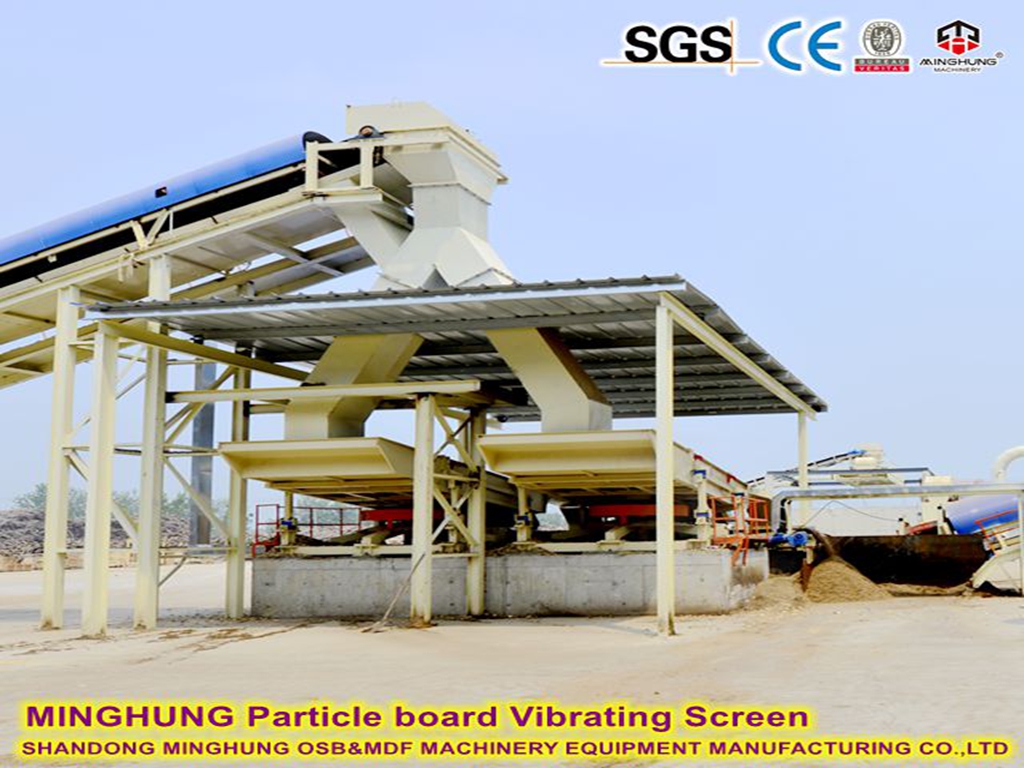
Once dried, the wood particles are classified through vibrating screens to separate them into fine particles for the surface layers and coarser particles for the core layer.
This separation is vital for creating a board that is both strong and smooth. The surface layers (the "skins" of the board) require very fine particles to provide a superior finish, while the core requires larger particles to provide structural rigidity and mechanical strength. This layering design is what makes particle board an engineered composite rather than just a compressed mass.
Grinding involves milling the oversized or coarse particles to achieve the desired refinement necessary for smooth, high-quality board surfaces.
Not all particles coming out of the separation stage are perfect. Some may be too large for the surface layer. These are diverted to a refiner or a hammer mill. The objective is to achieve a consistent particle geometry. If the particles are too fine, they consume excess glue; if they are too coarse, they create a rough surface.
This is where the engineering of the particle board manufacturing unit becomes evident. The precision of your refiner determines your surface quality. If you want to achieve a board surface that requires minimal secondary processing, you must invest in high-torque, adjustable grinding machinery.
Blending is the chemical heart of the process, where precise amounts of resin, wax, and curing agents are sprayed onto the particles in high-speed blenders.
We typically use Urea-Formaldehyde (UF) or Melamine-Urea-Formaldehyde (MUF) resins depending on the moisture-resistance requirements of the final product. The blending stage must be fast and thorough. We use specialized atomizing nozzles to ensure the resin covers each particle in a thin, uniform film.
Common additives include:
Wax emulsions for water repellency.
Hardening agents (catalysts) to speed up the curing process.
Fire-retardant chemicals for specific structural applications.
Getting the resin-to-wood ratio right is a balance between board strength and cost. Using too much resin increases production costs unnecessarily, while too little leads to board failure in the field.
Mat formation is the mechanical process of depositing the prepared, resin-coated wood furnish onto a conveyor belt to create a consistent, layered mat of specific thickness.
This process typically employs a "forming station" that spreads the material. For multi-layer boards, we use multiple forming stations: one for the fine surface layer, one for the coarse core, and one for the top surface layer. This "sandwich" construction is essential for creating a board that is perfectly balanced and won't warp once it leaves the press.
Advanced forming lines use gravitational and aerodynamic forces to ensure that the heavier, larger particles settle in the core, while the finer particles fall to the surfaces. This produces a cross-section density profile that is dense on the outside and slightly lighter in the middle, optimizing both strength and weight.
Pressing uses heat and high pressure to consolidate the loose mat into a rigid, cured board, permanently bonding the resin with the wood fibers.
This is the most critical stage of the entire production cycle. As an expert, I always recommend continuous pressing for modern facilities. Continuous hot presses offer superior control over the thickness and density profile of the board compared to traditional multi-opening presses. The heat (usually 160°C to 200°C) triggers the cross-linking of the resin, while the pressure ensures the board reaches the desired thickness and surface finish.
If you are scaling up your production, the throughput capacity of your press is the limiting factor. Our continuous hot press machine line is designed to provide consistent, 24/7 output, ensuring that the densification process remains uniform across every square meter of the panel.
Pressing Variable | Influence on Quality |
Press Pressure | Determines core compaction |
Press Temperature | Controls curing speed |
Residence Time | Ensures internal bond strength |
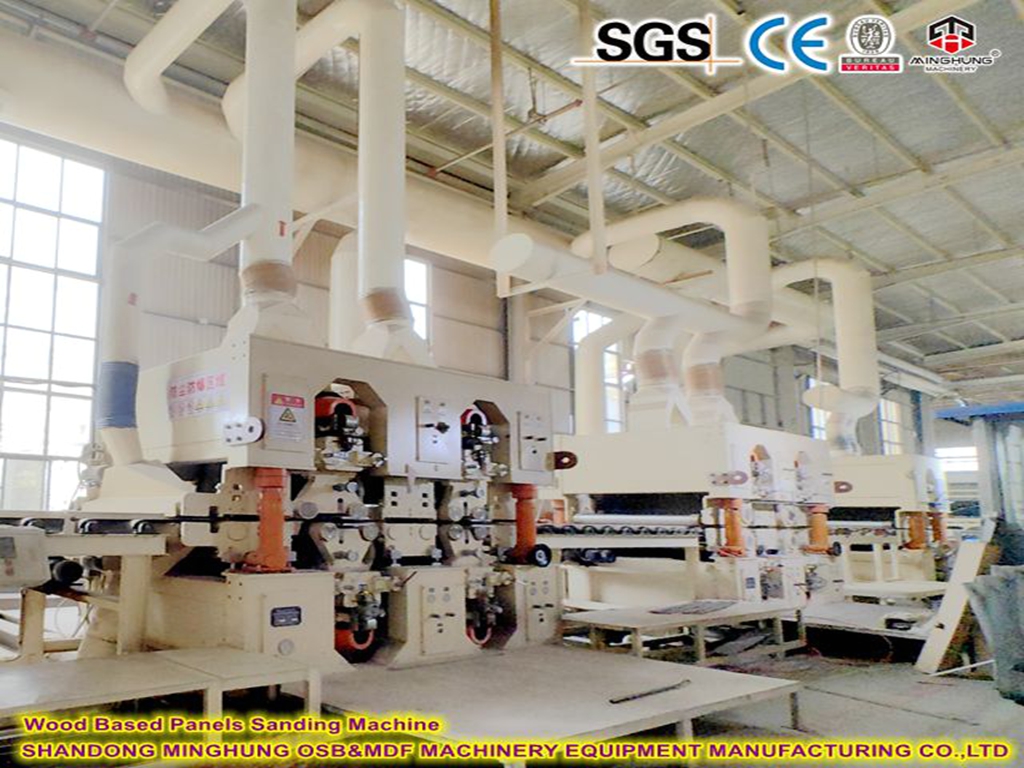
Once the board leaves the press, it must be cooled to room temperature before it can be trimmed to size and sanded to a uniform, finished thickness.
After the press, the panels are extremely hot. We use a "star cooler" to rotate the boards, allowing them to lose heat evenly. This prevents moisture pockets from forming, which could lead to board warping. Once cooled, the board edges are trimmed to the required dimensions (often 1220mm x 2440mm or larger).
Finally, the surface is sanded. This is a critical step because even the best production line will have minor surface variations. Sanding removes these, providing a smooth surface for customers. For those interested in how to properly manage this aspect, I recommend reading our guide on refinishing engineered wood surfaces to understand how to handle the surface integrity long-term.
Pro Tip: Always keep your sanding belts sharp. A dull belt will heat up the board surface, potentially causing resin degradation, which will lead to surface finish issues during later stages like veneer application or painting.
The final stage involves quality testing, grading, and packaging the particle boards for commercial distribution.
Quality control is the final gatekeeper. We conduct internal bond strength tests, modulus of rupture (MOR) tests, and moisture content checks on samples from every batch. Only after these tests confirm the board meets international standards (such as EN 312) is it labeled and stacked.
Manufacturing particle board is an intricate sequence of chemical and mechanical engineering. From the initial reduction of raw wood fibers through the sophisticated application of resins to the precision of continuous hot pressing, every stage demands rigorous attention to detail. By maintaining the integrity of each step—cleaning, drying, grading, and pressing—operators can guarantee the output of superior engineered panels. Investing in high-performance equipment and adhering to precise process parameters is not just about production volume; it is about establishing a standard of quality that wins long-term market trust.