| Availability: | |
|---|---|
MH
MINGHUNG

1. Overview & Core Philosophy
The Multi-Thickness OSB Production Line is an advanced design and manufacturing system built on the core philosophy of "One Line, Multiple Products, Adaptable Response." It breaks the limitation of traditional lines that are efficient only for producing a single or limited range of board thicknesses. On the same system, it can efficiently produce a full spectrum of OSB products, from thin to thick boards (e.g., 6mm to 40mm or wider), through rapid adjustment of process parameters and changeover of minimal components.
This production line is the ultimate solution for coping with diversified and volatile market demands. It allows manufacturers to switch between producing different thicknesses at any time based on customer orders, raw material supply, and market price fluctuations, thereby achieving maximized profitability and minimized inventory risk.
Production Process
The process of a multi-thickness OSB line builds upon the standard OSB process, with the core addition of "intelligent adjustment and flexible changeover" steps to enable seamless switching between thicknesses.
1. Raw Material Preparation Section
Chipping & Purification: Wood (logs, small-diameter wood, wood residues) is processed into uniform chips via a chipper. Chips are then cleaned and screened to remove impurities, yielding clean, acceptable chips.
Stranding & Drying: Acceptable chips are fed into a strand flaker to produce thin strands with a specific length-to-width ratio. The wet strands are then dried to a stable moisture content in a dryer.
2. Blending & Forming Section (Starting Point of Thickness Control)
Precision Blending: Dried strands are uniformly mixed with adhesive (e.g., pMDI, Phenolic Resin), wax, etc., in a blender.
Flexible Forming (Core Step 1): This is the first key to achieving multi-thickness capability. The resinated strands enter a programmable forming machine. Based on the currently set target thickness, the system automatically and precisely adjusts the speed and dosage of the forming heads to create a loose mat of specific thickness on a moving conveyor. The mat typically has a three-layer structure with surface strands oriented lengthwise and core strands oriented crosswise for high strength.
3. Pre-pressing & Conveying
The fluffy mat is lightly compacted in a pre-press to expel air and gain initial strength for transport into the press.
4. Hot Pressing & Curing Section (Core Step 2)
Flexible Continuous Press: Modern continuous presses use advanced hydraulic control systems to dynamically adjust the press inlet and outlet openings, as well as the internal pressure profile, to accommodate the pressing requirements of different mat thicknesses.
Under high temperature and pressure, the adhesive cures rapidly, bonding the oriented strands into a solid OSB panel.
5. Finishing & Sorting Section
Cooling & Trimming: The pressed panels are cooled to stabilize dimensions and stress, then cut to standard format and their dense edges are trimmed by cross-cut and trim saws.
Sanding & Sorting: Panels are calibrated and surface-finished by a sander. A multi-thickness line requires a sander with a greater thickness adjustment range and high-precision control.
Automatic Stacking & Bundling: Finally, an automatic sorting system can stack, bundle, and route panels to storage based on their thickness, enabling efficient order management.

Core Production Equipment Details
1. Raw Material Handling Equipment
Strand Flaker: Produces uniform, high-quality thin strands, which is fundamental for ensuring subsequent orientation and board quality.
Rotary Drum Dryer: Dries strands to a uniform and stable moisture content, ensuring bonding quality.
2. Forming & Blending Equipment (Key to Flexibility)
Programmable Precision Forming Machine: A core component. Equipped with online scanners to monitor the thickness and weight per unit area of the mat in real-time, providing feedback for closed-loop control to ensure uniformity for mats from 6mm to 30mm.
High-Speed Blender: Ensures uniform and efficient mixing of resin and additives with the strands.
3. Pressing Section Equipment (Core Technology Assets)
Flexible Continuous Press: Advantages include high production efficiency, unlimited panel length, and excellent surface quality. Its flexible pressing system embodies the technology for multi-thickness production.
Automatic Loading & Unloading System: Paired with multi-opening presses for automated handling, maintaining production rhythm.
4. Finishing Section Equipment
Cooling Star/Turnover Cooler: Cools panels uniformly to prevent warping.
High-Precision Cross-Cut & Trim Saws: Perform fast, accurate length and width cutting.
Wide-Belt Calibrating Sander: Possesses powerful sanding capacity and a wide thickness adjustment range, capable of handling all panels from the thinnest to the thickest, ensuring final product thickness tolerance and surface smoothness.
5. Plant-Wide Intelligent Control System (The "Brain")
Central Control Room & MES (Manufacturing Execution System): This is the nerve center. The system stores "process recipes" for all product thicknesses. When a thickness change is needed, the operator simply calls up the recipe, and the system automatically commands all relevant equipment (former, press, sander, etc.) to adjust parameters, enabling fast and precise product changeover.
Core Advantages of the Multi-Thickness OSB Production Line
1. Unparalleled Market Flexibility & Rapid Response Capability
"One-Stop" Solution for Diverse Needs: A single line covers the full product range from thin (e.g., 6-8mm) to thick (e.g., 25-40mm) boards, easily handling orders from various sectors like construction, interior decoration, and packaging.
Seize Market Opportunities: When demand or prices surge for a specific thickness, the line can switch production thickness in a very short time (e.g., within a single shift), enabling rapid production of high-margin products to capitalize on market trends, without waiting for lengthy line modifications or new investments.
2. Significant Economic Benefits & High ROI
Reduced Capital Expenditure (CAPEX): Clients avoid the need to invest in multiple dedicated lines for different thickness specifications. "One line for multiple uses" drastically saves on land, building, equipment, and infrastructure costs.
Improved Equipment Utilization & OEE: Prevents equipment idleness or overcapacity due to a single-product focus. The line can always produce according to the most profitable orders, maximizing Overall Equipment Effectiveness (OEE).
Minimized Changeover Loss: Optimized automated design reduces material waste, energy waste, and downtime during product thickness changeovers, directly lowering operating costs.
3. Exceptional Production Efficiency & Consistent Product Quality
Batch Customization & High Efficiency: Leveraging the unique advantage of a Multi-Opening Hot Press, it can produce multiple panels of different thicknesses simultaneously within a single press cycle. This achieves true "batch customization," with production efficiency far exceeding that of single-thickness lines.
Guaranteed Quality Consistency: The advanced intelligent control system stores optimized "process recipes" for each thickness, ensuring that key indicators like density uniformity, internal bond strength, and formaldehyde emissions remain stable and controllable, meeting the highest standards regardless of the thickness being produced.
4. Robust Risk Management & Supply Chain Resilience
Mitigates Market Volatility Risk: By not relying on a single product, the business can immediately shift to other in-demand specifications if one market segment weakens, acting as a "multi-layered insurance" policy that enhances corporate resilience.
Optimizes Inventory Management: Enables a "Make-To-Order" model, significantly reducing finished goods inventory and capital tied up, while also allowing for quick delivery of small-batch, multi-specification urgent orders, boosting customer satisfaction.
5. Future-Oriented Sustainability & Environmental Value
Maximized Resource Efficiency: The line itself is a model of resource efficiency, using one set of equipment to meet a wide range of market demands, reducing the resource consumption associated with redundant construction.
Supports Green Product Manufacturing: The line is readily adaptable for use with eco-friendly adhesives (e.g., MDI) to produce No-Added-Formaldehyde (NAF) green OSB panels, helping end-customers achieve green building certifications and enhancing product added value.
In summary, the core value of this production line lies in its transformation from a traditional "mass production" tool into a powerful "profit engine" and "strategic asset," granting investors unprecedented flexibility and initiative in the fierce global market competition.
How is Multi-Thickness Specification Achieved?
The realization of a multi-thickness OSB production line does not rely on the magic of a single piece of equipment, but is achieved through a highly coordinated "Flexible Manufacturing System". The core lies in the precise coordination of three major systems.
1. Intelligent Adjustable Forming System - Controlling the "Raw Material" Dosage
This is the first key link in achieving multiple thicknesses, determining the initial thickness of the mat (the loose layer of strands before pressing).
Working Principle: The forming machine is like the production line's "3D printer", responsible for spreading the resinated strands onto a moving steel belt to form the mat.
How It Achieves Multi-Thickness:
When a thicker panel is needed, the control system commands the forming heads to increase their oscillation frequency or the conveyor speed, laying down a thicker mat.
When a thinner panel is needed, it reduces the strand dosage.
Core Technology: It is equipped with online scanning gauges that monitor the mat's thickness and weight per unit area in real-time, feeding this data back to the control system to form a closed-loop control. This ensures that mats from 6mm to 30mm can achieve the preset, uniform weight and thickness distribution.
2. Flexible Hot Pressing System - The Final "Shaping" Step
This is the "heart" of the entire production line, the part with the highest technological content that best reflects the multi-thickness capability.
Flexible Continuous Press - The Combination of Efficiency and Flexibility
Working Principle: The mat is continuously cured as it is sandwiched between two giant steel belts and passes through a long heated press.
How It Achieves Multi-Thickness: Through an advanced hydraulic control system, it dynamically adjusts the opening at the press inlet and outlet, as well as the pressure profile in internal zones. When producing thick panels, the inlet opening increases; when producing thin panels, it decreases.
Advantage: High production efficiency, unlimited panel length, and excellent surface quality. However, its flexibility and range for thickness changeover are generally not as great as those of a multi-opening press.
3. Adaptive Intelligent Control System - The Brain of the Production Line
This is the "neural network" that connects all the above equipment, the unseen hero enabling one-touch changeover.
Working Principle: The system stores "Process Recipes" corresponding to all product thicknesses.
How It Achieves Multi-Thickness: When an operator needs to switch from producing 15mm panels to 22mm panels, they simply select the "22mm" recipe in the control room and press start. The system automatically executes the following commands:
1. Commands the Forming Station to increase the dosage, thickening the mat.
2. Commands the Blender to proportionally increase the output of resin and additives.
3. Commands the Hot Press to adjust to the press opening, pressure, and press time corresponding to 22mm.
4. Commands the Sanding Machine to adjust the sanding baseline, ensuring final thickness accuracy.
Advantage: It avoids complex manual calculations and adjustments, greatly reduces changeover time, and ensures precise process replication and stable product quality.
In simple terms, achieving multi-thickness specification is like a master chef cooking:
The Forming System controls the amount of "ingredients" dispensed.
The Hot Press System is the smart oven, capable of setting different heat levels and times for loaves of bread of different thicknesses.
The Control System is the chef's recipe and brain, ensuring every batch is perfect.
The seamless collaboration of these three elements transforms a single production line into a flexible, intelligent "assembly line," effortlessly handling the market's diverse demands for OSB panel thicknesses.
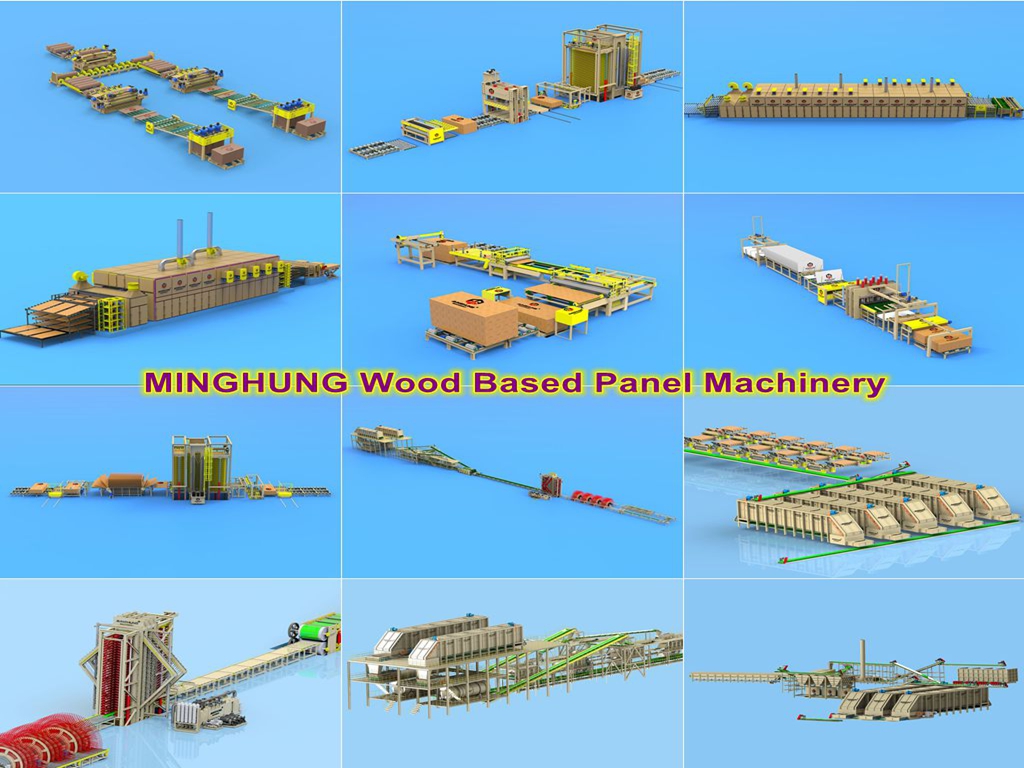
We are China professional factory and supplier of OSB board making machine, MDF/HDF making machine and Flakeboard/Particleboard making machine. Whatever which size, thickness, capacity you want to make, and whatever what kinds of raw materials do you use, our professional team can offer a suitable and good solution for you.
From A to Z, from Raw materials to the final wood based panel, we can offer you all necessary machinery. including: Wood chipper, Strander, Disc chipper, Ring flaker, Rotary drum dryer, Vibrating screener, Glue dosing and applying system, Refiner, Mat frorming line, Continuous pre-press, synchronous Cross-cut saw, Multi-layers Hot press /Continuous single layer hot press, Auto edge trimming machine line,Sanding line,etc.
We provide comprehensive turnkey project services, from planning and design, equipment manufacturing, to installation and commissioning, ensuring a swift startup for our clients. The line can be personalized based on your specific raw material characteristics (e.g., mixed wood, recycled wood) and annual production capacity requirements (spanning from tens of thousands to hundreds of thousands of cubic meters). Choosing our Multi-Thickness OSB Production Line is a strategic decision to enhance your market competitiveness and achieve product diversification and profit maximization.
Our contacts:
Whatsapp: +8618769900191 +8615589105786 +8618954906501
Email: osbmdfmachinery@gmail.com

1. Overview & Core Philosophy
The Multi-Thickness OSB Production Line is an advanced design and manufacturing system built on the core philosophy of "One Line, Multiple Products, Adaptable Response." It breaks the limitation of traditional lines that are efficient only for producing a single or limited range of board thicknesses. On the same system, it can efficiently produce a full spectrum of OSB products, from thin to thick boards (e.g., 6mm to 40mm or wider), through rapid adjustment of process parameters and changeover of minimal components.
This production line is the ultimate solution for coping with diversified and volatile market demands. It allows manufacturers to switch between producing different thicknesses at any time based on customer orders, raw material supply, and market price fluctuations, thereby achieving maximized profitability and minimized inventory risk.
Production Process
The process of a multi-thickness OSB line builds upon the standard OSB process, with the core addition of "intelligent adjustment and flexible changeover" steps to enable seamless switching between thicknesses.
1. Raw Material Preparation Section
Chipping & Purification: Wood (logs, small-diameter wood, wood residues) is processed into uniform chips via a chipper. Chips are then cleaned and screened to remove impurities, yielding clean, acceptable chips.
Stranding & Drying: Acceptable chips are fed into a strand flaker to produce thin strands with a specific length-to-width ratio. The wet strands are then dried to a stable moisture content in a dryer.
2. Blending & Forming Section (Starting Point of Thickness Control)
Precision Blending: Dried strands are uniformly mixed with adhesive (e.g., pMDI, Phenolic Resin), wax, etc., in a blender.
Flexible Forming (Core Step 1): This is the first key to achieving multi-thickness capability. The resinated strands enter a programmable forming machine. Based on the currently set target thickness, the system automatically and precisely adjusts the speed and dosage of the forming heads to create a loose mat of specific thickness on a moving conveyor. The mat typically has a three-layer structure with surface strands oriented lengthwise and core strands oriented crosswise for high strength.
3. Pre-pressing & Conveying
The fluffy mat is lightly compacted in a pre-press to expel air and gain initial strength for transport into the press.
4. Hot Pressing & Curing Section (Core Step 2)
Flexible Continuous Press: Modern continuous presses use advanced hydraulic control systems to dynamically adjust the press inlet and outlet openings, as well as the internal pressure profile, to accommodate the pressing requirements of different mat thicknesses.
Under high temperature and pressure, the adhesive cures rapidly, bonding the oriented strands into a solid OSB panel.
5. Finishing & Sorting Section
Cooling & Trimming: The pressed panels are cooled to stabilize dimensions and stress, then cut to standard format and their dense edges are trimmed by cross-cut and trim saws.
Sanding & Sorting: Panels are calibrated and surface-finished by a sander. A multi-thickness line requires a sander with a greater thickness adjustment range and high-precision control.
Automatic Stacking & Bundling: Finally, an automatic sorting system can stack, bundle, and route panels to storage based on their thickness, enabling efficient order management.

Core Production Equipment Details
1. Raw Material Handling Equipment
Strand Flaker: Produces uniform, high-quality thin strands, which is fundamental for ensuring subsequent orientation and board quality.
Rotary Drum Dryer: Dries strands to a uniform and stable moisture content, ensuring bonding quality.
2. Forming & Blending Equipment (Key to Flexibility)
Programmable Precision Forming Machine: A core component. Equipped with online scanners to monitor the thickness and weight per unit area of the mat in real-time, providing feedback for closed-loop control to ensure uniformity for mats from 6mm to 30mm.
High-Speed Blender: Ensures uniform and efficient mixing of resin and additives with the strands.
3. Pressing Section Equipment (Core Technology Assets)
Flexible Continuous Press: Advantages include high production efficiency, unlimited panel length, and excellent surface quality. Its flexible pressing system embodies the technology for multi-thickness production.
Automatic Loading & Unloading System: Paired with multi-opening presses for automated handling, maintaining production rhythm.
4. Finishing Section Equipment
Cooling Star/Turnover Cooler: Cools panels uniformly to prevent warping.
High-Precision Cross-Cut & Trim Saws: Perform fast, accurate length and width cutting.
Wide-Belt Calibrating Sander: Possesses powerful sanding capacity and a wide thickness adjustment range, capable of handling all panels from the thinnest to the thickest, ensuring final product thickness tolerance and surface smoothness.
5. Plant-Wide Intelligent Control System (The "Brain")
Central Control Room & MES (Manufacturing Execution System): This is the nerve center. The system stores "process recipes" for all product thicknesses. When a thickness change is needed, the operator simply calls up the recipe, and the system automatically commands all relevant equipment (former, press, sander, etc.) to adjust parameters, enabling fast and precise product changeover.
Core Advantages of the Multi-Thickness OSB Production Line
1. Unparalleled Market Flexibility & Rapid Response Capability
"One-Stop" Solution for Diverse Needs: A single line covers the full product range from thin (e.g., 6-8mm) to thick (e.g., 25-40mm) boards, easily handling orders from various sectors like construction, interior decoration, and packaging.
Seize Market Opportunities: When demand or prices surge for a specific thickness, the line can switch production thickness in a very short time (e.g., within a single shift), enabling rapid production of high-margin products to capitalize on market trends, without waiting for lengthy line modifications or new investments.
2. Significant Economic Benefits & High ROI
Reduced Capital Expenditure (CAPEX): Clients avoid the need to invest in multiple dedicated lines for different thickness specifications. "One line for multiple uses" drastically saves on land, building, equipment, and infrastructure costs.
Improved Equipment Utilization & OEE: Prevents equipment idleness or overcapacity due to a single-product focus. The line can always produce according to the most profitable orders, maximizing Overall Equipment Effectiveness (OEE).
Minimized Changeover Loss: Optimized automated design reduces material waste, energy waste, and downtime during product thickness changeovers, directly lowering operating costs.
3. Exceptional Production Efficiency & Consistent Product Quality
Batch Customization & High Efficiency: Leveraging the unique advantage of a Multi-Opening Hot Press, it can produce multiple panels of different thicknesses simultaneously within a single press cycle. This achieves true "batch customization," with production efficiency far exceeding that of single-thickness lines.
Guaranteed Quality Consistency: The advanced intelligent control system stores optimized "process recipes" for each thickness, ensuring that key indicators like density uniformity, internal bond strength, and formaldehyde emissions remain stable and controllable, meeting the highest standards regardless of the thickness being produced.
4. Robust Risk Management & Supply Chain Resilience
Mitigates Market Volatility Risk: By not relying on a single product, the business can immediately shift to other in-demand specifications if one market segment weakens, acting as a "multi-layered insurance" policy that enhances corporate resilience.
Optimizes Inventory Management: Enables a "Make-To-Order" model, significantly reducing finished goods inventory and capital tied up, while also allowing for quick delivery of small-batch, multi-specification urgent orders, boosting customer satisfaction.
5. Future-Oriented Sustainability & Environmental Value
Maximized Resource Efficiency: The line itself is a model of resource efficiency, using one set of equipment to meet a wide range of market demands, reducing the resource consumption associated with redundant construction.
Supports Green Product Manufacturing: The line is readily adaptable for use with eco-friendly adhesives (e.g., MDI) to produce No-Added-Formaldehyde (NAF) green OSB panels, helping end-customers achieve green building certifications and enhancing product added value.
In summary, the core value of this production line lies in its transformation from a traditional "mass production" tool into a powerful "profit engine" and "strategic asset," granting investors unprecedented flexibility and initiative in the fierce global market competition.
How is Multi-Thickness Specification Achieved?
The realization of a multi-thickness OSB production line does not rely on the magic of a single piece of equipment, but is achieved through a highly coordinated "Flexible Manufacturing System". The core lies in the precise coordination of three major systems.
1. Intelligent Adjustable Forming System - Controlling the "Raw Material" Dosage
This is the first key link in achieving multiple thicknesses, determining the initial thickness of the mat (the loose layer of strands before pressing).
Working Principle: The forming machine is like the production line's "3D printer", responsible for spreading the resinated strands onto a moving steel belt to form the mat.
How It Achieves Multi-Thickness:
When a thicker panel is needed, the control system commands the forming heads to increase their oscillation frequency or the conveyor speed, laying down a thicker mat.
When a thinner panel is needed, it reduces the strand dosage.
Core Technology: It is equipped with online scanning gauges that monitor the mat's thickness and weight per unit area in real-time, feeding this data back to the control system to form a closed-loop control. This ensures that mats from 6mm to 30mm can achieve the preset, uniform weight and thickness distribution.
2. Flexible Hot Pressing System - The Final "Shaping" Step
This is the "heart" of the entire production line, the part with the highest technological content that best reflects the multi-thickness capability.
Flexible Continuous Press - The Combination of Efficiency and Flexibility
Working Principle: The mat is continuously cured as it is sandwiched between two giant steel belts and passes through a long heated press.
How It Achieves Multi-Thickness: Through an advanced hydraulic control system, it dynamically adjusts the opening at the press inlet and outlet, as well as the pressure profile in internal zones. When producing thick panels, the inlet opening increases; when producing thin panels, it decreases.
Advantage: High production efficiency, unlimited panel length, and excellent surface quality. However, its flexibility and range for thickness changeover are generally not as great as those of a multi-opening press.
3. Adaptive Intelligent Control System - The Brain of the Production Line
This is the "neural network" that connects all the above equipment, the unseen hero enabling one-touch changeover.
Working Principle: The system stores "Process Recipes" corresponding to all product thicknesses.
How It Achieves Multi-Thickness: When an operator needs to switch from producing 15mm panels to 22mm panels, they simply select the "22mm" recipe in the control room and press start. The system automatically executes the following commands:
1. Commands the Forming Station to increase the dosage, thickening the mat.
2. Commands the Blender to proportionally increase the output of resin and additives.
3. Commands the Hot Press to adjust to the press opening, pressure, and press time corresponding to 22mm.
4. Commands the Sanding Machine to adjust the sanding baseline, ensuring final thickness accuracy.
Advantage: It avoids complex manual calculations and adjustments, greatly reduces changeover time, and ensures precise process replication and stable product quality.
In simple terms, achieving multi-thickness specification is like a master chef cooking:
The Forming System controls the amount of "ingredients" dispensed.
The Hot Press System is the smart oven, capable of setting different heat levels and times for loaves of bread of different thicknesses.
The Control System is the chef's recipe and brain, ensuring every batch is perfect.
The seamless collaboration of these three elements transforms a single production line into a flexible, intelligent "assembly line," effortlessly handling the market's diverse demands for OSB panel thicknesses.
We are China professional factory and supplier of OSB board making machine, MDF/HDF making machine and Flakeboard/Particleboard making machine. Whatever which size, thickness, capacity you want to make, and whatever what kinds of raw materials do you use, our professional team can offer a suitable and good solution for you.
From A to Z, from Raw materials to the final wood based panel, we can offer you all necessary machinery. including: Wood chipper, Strander, Disc chipper, Ring flaker, Rotary drum dryer, Vibrating screener, Glue dosing and applying system, Refiner, Mat frorming line, Continuous pre-press, synchronous Cross-cut saw, Multi-layers Hot press /Continuous single layer hot press, Auto edge trimming machine line,Sanding line,etc.
We provide comprehensive turnkey project services, from planning and design, equipment manufacturing, to installation and commissioning, ensuring a swift startup for our clients. The line can be personalized based on your specific raw material characteristics (e.g., mixed wood, recycled wood) and annual production capacity requirements (spanning from tens of thousands to hundreds of thousands of cubic meters). Choosing our Multi-Thickness OSB Production Line is a strategic decision to enhance your market competitiveness and achieve product diversification and profit maximization.
Our contacts:
Whatsapp: +8618769900191 +8615589105786 +8618954906501
Email: osbmdfmachinery@gmail.com