| Availability: | |
|---|---|
MH-CHP
MINGHUNG

|
Core Concept & Significance
An Adjustable Width Continuous Laminating Press is a revolutionary piece of industrial equipment, distinguished by its ability to have its effective working width adjusted within a preset range (e.g., 1220 mm to 2800 mm) either steplessly or in steps. This fundamentally breaks the technological barrier of traditional continuous presses, which have a fixed working width and can only produce products of a single specification.
Its significance lies in:
The Leap from "Rigid Production" to "Flexible Manufacturing": Traditional production lines are designed for specific products, whereas the adjustable width press enables "multiple products on one machine," vastly enhancing production line flexibility and market adaptability.
A Powerful Tool for Market Responsiveness: Allows for quick response to market demands for small-batch, high-mix, and customized products without the need to invest in entirely new production lines for each new product width.
Reduction in Total Cost of Ownership: While the initial investment for a single machine might be higher, it consolidates the functions of multiple fixed-width lines, leading to overall savings in equipment purchase cost, floor space, installation costs, and operational manpower.
|
Continuous Hot Press
A Continuous Laminating Hot Press is a high-efficiency industrial machine that employs a continuous operation principle to simultaneously apply heat and pressure to strip or sheet materials, causing physical and chemical changes such as curing, bonding, setting, and densification.
The fundamental difference from traditional intermittent (opening-and-closing) hot presses is that during production, the material passes through the press uninterruptedly, driven by steel belts, achieving a fully continuous process from feeding, heating/pressing, to discharging.
|
Working Principle
After the material is evenly formed and pre-pressed by the feeding system, it enters the press, sandwiched between two high-strength steel belts. The steel belts carry the material between precision heating platens. During operation:
The Heating System (typically electrically, steam, or thermal oil-heated platens) provides uniform and stable high temperatures.
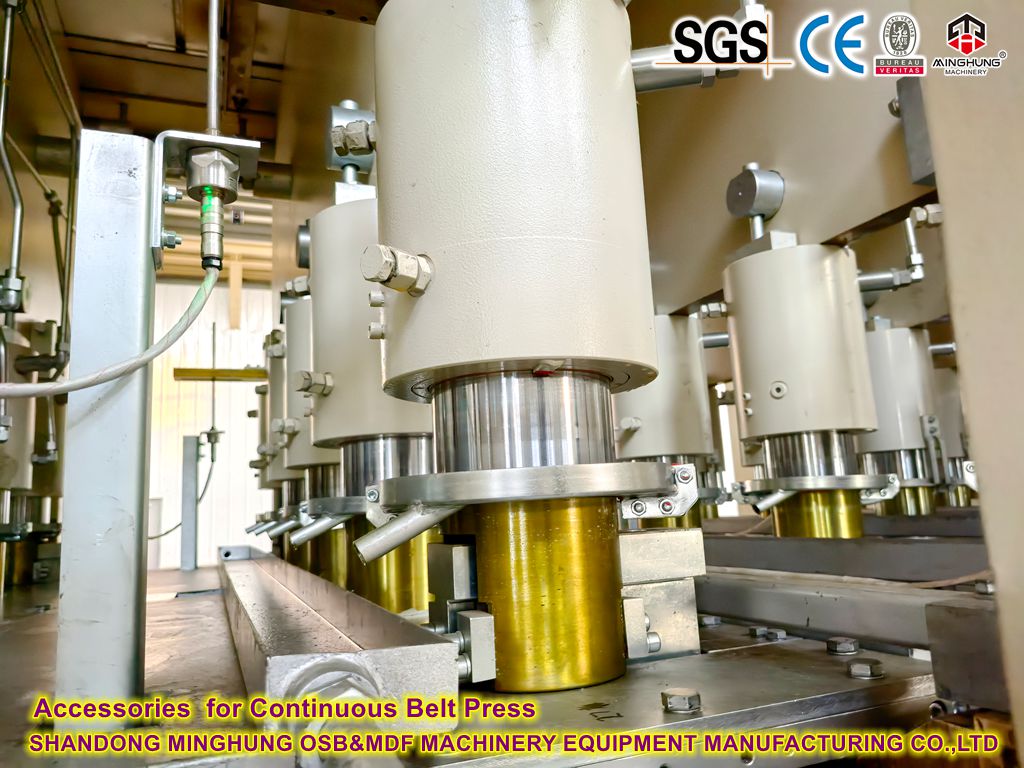
The Pressure System (via hydraulic cylinder-driven pressure pads or a series of pressure rollers) applies continuous and controllable pressure perpendicular to the panel surface.
Under the set temperature, pressure, and speed, the material completes its physico-chemical reactions (e.g., resin curing, fiber bonding) inside the press, and the final formed panel is continuously discharged from the other end.
|
Main Structural Components
1. Steel Belt System: The core conveying and pressure-transferring component, requiring high-temperature resistance, high strength, and a smooth surface.
2. Heating System: Multiple independent heating platens allowing for zonal temperature control to create an ideal temperature field.
3. Pressure System: Comprises the hydraulic power unit, cylinders, and pressure pads/rollers, forming the core of pressure generation.
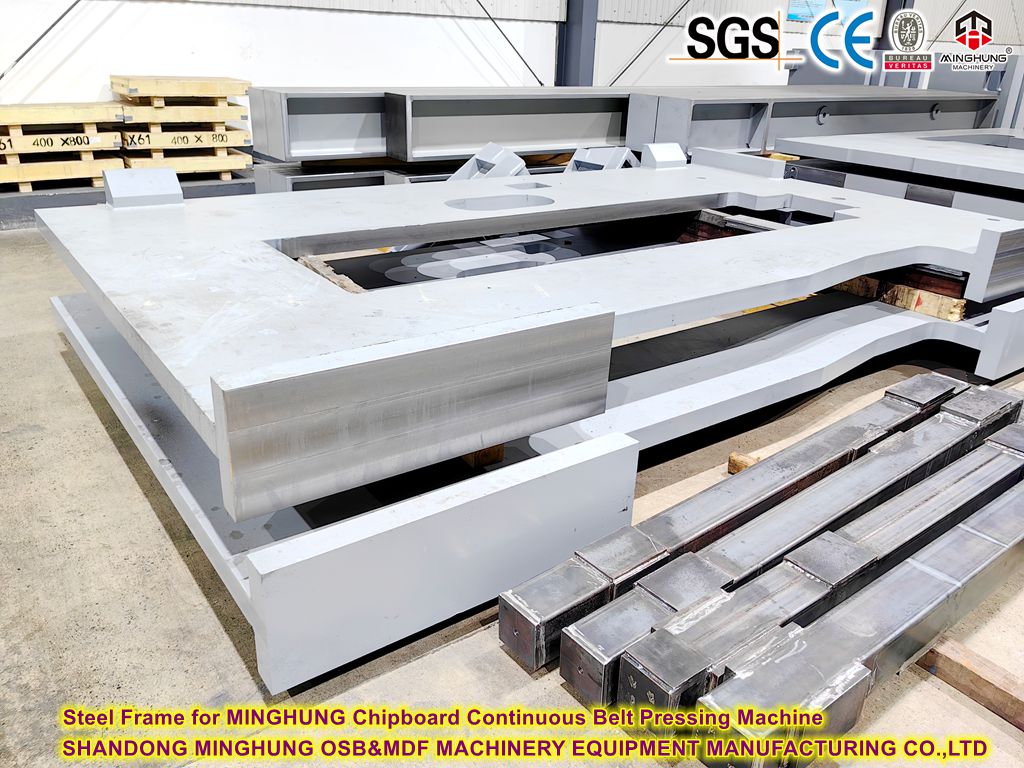
4. Frame: A robust steel structure supporting all components and withstanding enormous working pressure.
5. Drive System: Motors and reduction gearboxes that drive the continuous movement of the steel belts.
6. Control System: Utilizes a PLC (Programmable Logic Controller) and touchscreen HMI for precise control and recipe storage of parameters like temperature, pressure, speed, and thickness.
|
Technical Parameters
Parameter | Typical Range / Description |
Working Width | 1200mm, 1400mm, 1800mm, 2400mm, 2600mm, 2800mm, etc. |
Max. Working Pressure | Customized based on product requirements, can reach thousands of tons |
Heating Method | Steam, Thermal Oil, Electric Heating |
Max. Working Temperature | 200℃ - 300℃ |
Production Speed | Adjustable based on process, ranging from tens of seconds/meter to several meters/minute |
Control Core | PLC + Industrial Touchscreen |
|
How is Width Adjustment Achieved?
Achieving width adjustment in a continuous press is a complex systems engineering challenge, primarily involving innovations in the following key technologies:
1. Modular Frame & Side Beam Design
Principle: The main frames on both sides of the press are no longer fixed structures but are designed as movable "side beams." Powerful drive systems (typically servo motor-driven gear-rack systems or hydraulic synchronization cylinders) move these two side beams synchronously and parallelly on precision guide rails, changing the distance between them.
Key Technology: The synchronization accuracy of the two side beams is critical. They must remain perfectly parallel during movement to prevent jamming or damage.
2. Adjustable Width Heating Platen System
Principle: The internal heating platens must also adapt to the changing working width. Two common solutions are:
Segmented/Modular Design: Heating platens are designed as multiple standard sections and expandable sections. Width adjustment involves automatically or manually adding, removing, or replacing platen segments.
Integrated Adjustable Design: Using specially designed elongated platens where the effective heating zone is adjusted internally, though this is technologically more challenging.
Challenge: A uniform and stable temperature field, along with effective sealing to prevent heat loss, must be guaranteed at any width setting.
3. Adaptive Steel Belt Guidance & Tensioning System
Principle: The mounting bases for the belt guide rollers and tension rollers must also move synchronously with the side beams. The system requires automatic edge control functionality to ensure stable belt operation without deviation at all widths.
Key Technology: An intelligent belt guiding system that detects the belt position in real-time and makes dynamic adjustments.
4. Variable Width Pressure System
Principle: The arrangement of pressure-generating elements (whether pressure pads or pressure rollers) must adapt to the width change. This is typically achieved through:
Modular Pressure Pads: Pads are modular, corresponding to the heating platen modules, ensuring pressure is applied evenly across the entire platen surface at any width.
Adjustable Pressure Roller Arrays: The support points for pressure rollers can be repositioned to match the new working width.
5. Integrated Intelligent Control System
Principle: This is the "brain" of the entire machine. An operator simply inputs the target width on the HMI, and the control system automatically executes a series of coordinated actions:
1. Moves the side beams to the target position.
2. Adjusts the heating platen modules.
3. Reconfigures the belt guide and tensioning system.
4. Updates parameters for the pressure system.
5. Recalls the optimized process recipe (temperature, pressure, speed profile) for that specific width.
|
Primary Application Scenarios
Wood-Based Panel Industry: Simultaneously produce Particleboard, MDF, OSB of different widths and specifications to meet the needs of various customers in furniture manufacturing and construction.
Composite Materials Industry:Used for producing Carbon Fiber Prepreg Sheets, SMC Sheets, GMT Panels, etc., which often require various widths for different downstream applications (e.g., automotive parts, sporting goods).
Building Insulation & Decorative Materials:Such as Rock Wool Boards, Gypsum Boards, Metal Composite Panels, where diverse building modules create different width requirements.
Rubber & Textile Industry:Production of Conveyor Belts, Rubber Mats, Coated Fabrics in different widths.
|
Product Packaging
|
Application Video
|
Comment & FAQ
Q:Are you a factory or a trading company?
A:We are an industry and trade integrated company with 20 years of experience.
Q:How to choose the right machine?
A:We will check and confirm the type of furniture you manufacture, the process used and the size of the board to recommend the most suitable machine to you.
Q:Can you do OEM /ODM?
A:Yes, we can do OEM/ODM according to your technical requirements.
Q:What payment methods do you offer?
A:Usually T/T and LC. If you have other payment methods, we can also consider it.
|
Company Profile
Shandong MingHung OSB&MDF Machinery Equipment is a China professional factory who specilize in manufacturering and offering Wood based panel machine, including OSB making machine, MDF making machine, and Chipboard /PB making machine.
The machines we can offer includes: Wood chipper, Ring flaker, Strander, Wet silo, Drum dryer, Dry silo, Glue dosing and applying system /Glue blender, Mat forming, Continuous Multi-rolls pre-press, Multi opening hot press and Continuous press, Auto edge cutting machine line, Sanding machine line, kinds of related belt conveyor and so on.
|
Certifications
Why Choose Our Adjustable Width Continuous Laminating Press?
We are committed to providing customers with future-oriented intelligent manufacturing solutions. This machine is not just a production tool; it is a strategic asset for enhancing your competitiveness and achieving business growth.
Upgrade your production line now!
We provide global installation support and technical training, 2-year machine warranty, and 24-hour online response.
Whatsapp: +8618769900191 +8615589105786 +8618954906501
Email: osbmdfmachinery@gmail.com

|
Core Concept & Significance
An Adjustable Width Continuous Laminating Press is a revolutionary piece of industrial equipment, distinguished by its ability to have its effective working width adjusted within a preset range (e.g., 1220 mm to 2800 mm) either steplessly or in steps. This fundamentally breaks the technological barrier of traditional continuous presses, which have a fixed working width and can only produce products of a single specification.
Its significance lies in:
The Leap from "Rigid Production" to "Flexible Manufacturing": Traditional production lines are designed for specific products, whereas the adjustable width press enables "multiple products on one machine," vastly enhancing production line flexibility and market adaptability.
A Powerful Tool for Market Responsiveness: Allows for quick response to market demands for small-batch, high-mix, and customized products without the need to invest in entirely new production lines for each new product width.
Reduction in Total Cost of Ownership: While the initial investment for a single machine might be higher, it consolidates the functions of multiple fixed-width lines, leading to overall savings in equipment purchase cost, floor space, installation costs, and operational manpower.
|
Continuous Hot Press
A Continuous Laminating Hot Press is a high-efficiency industrial machine that employs a continuous operation principle to simultaneously apply heat and pressure to strip or sheet materials, causing physical and chemical changes such as curing, bonding, setting, and densification.
The fundamental difference from traditional intermittent (opening-and-closing) hot presses is that during production, the material passes through the press uninterruptedly, driven by steel belts, achieving a fully continuous process from feeding, heating/pressing, to discharging.
|
Working Principle
After the material is evenly formed and pre-pressed by the feeding system, it enters the press, sandwiched between two high-strength steel belts. The steel belts carry the material between precision heating platens. During operation:
The Heating System (typically electrically, steam, or thermal oil-heated platens) provides uniform and stable high temperatures.
The Pressure System (via hydraulic cylinder-driven pressure pads or a series of pressure rollers) applies continuous and controllable pressure perpendicular to the panel surface.
Under the set temperature, pressure, and speed, the material completes its physico-chemical reactions (e.g., resin curing, fiber bonding) inside the press, and the final formed panel is continuously discharged from the other end.
|
Main Structural Components
1. Steel Belt System: The core conveying and pressure-transferring component, requiring high-temperature resistance, high strength, and a smooth surface.
2. Heating System: Multiple independent heating platens allowing for zonal temperature control to create an ideal temperature field.
3. Pressure System: Comprises the hydraulic power unit, cylinders, and pressure pads/rollers, forming the core of pressure generation.
4. Frame: A robust steel structure supporting all components and withstanding enormous working pressure.
5. Drive System: Motors and reduction gearboxes that drive the continuous movement of the steel belts.
6. Control System: Utilizes a PLC (Programmable Logic Controller) and touchscreen HMI for precise control and recipe storage of parameters like temperature, pressure, speed, and thickness.
|
Technical Parameters
Parameter | Typical Range / Description |
Working Width | 1200mm, 1400mm, 1800mm, 2400mm, 2600mm, 2800mm, etc. |
Max. Working Pressure | Customized based on product requirements, can reach thousands of tons |
Heating Method | Steam, Thermal Oil, Electric Heating |
Max. Working Temperature | 200℃ - 300℃ |
Production Speed | Adjustable based on process, ranging from tens of seconds/meter to several meters/minute |
Control Core | PLC + Industrial Touchscreen |
|
How is Width Adjustment Achieved?
Achieving width adjustment in a continuous press is a complex systems engineering challenge, primarily involving innovations in the following key technologies:
1. Modular Frame & Side Beam Design
Principle: The main frames on both sides of the press are no longer fixed structures but are designed as movable "side beams." Powerful drive systems (typically servo motor-driven gear-rack systems or hydraulic synchronization cylinders) move these two side beams synchronously and parallelly on precision guide rails, changing the distance between them.
Key Technology: The synchronization accuracy of the two side beams is critical. They must remain perfectly parallel during movement to prevent jamming or damage.
2. Adjustable Width Heating Platen System
Principle: The internal heating platens must also adapt to the changing working width. Two common solutions are:
Segmented/Modular Design: Heating platens are designed as multiple standard sections and expandable sections. Width adjustment involves automatically or manually adding, removing, or replacing platen segments.
Integrated Adjustable Design: Using specially designed elongated platens where the effective heating zone is adjusted internally, though this is technologically more challenging.
Challenge: A uniform and stable temperature field, along with effective sealing to prevent heat loss, must be guaranteed at any width setting.
3. Adaptive Steel Belt Guidance & Tensioning System
Principle: The mounting bases for the belt guide rollers and tension rollers must also move synchronously with the side beams. The system requires automatic edge control functionality to ensure stable belt operation without deviation at all widths.
Key Technology: An intelligent belt guiding system that detects the belt position in real-time and makes dynamic adjustments.
4. Variable Width Pressure System
Principle: The arrangement of pressure-generating elements (whether pressure pads or pressure rollers) must adapt to the width change. This is typically achieved through:
Modular Pressure Pads: Pads are modular, corresponding to the heating platen modules, ensuring pressure is applied evenly across the entire platen surface at any width.
Adjustable Pressure Roller Arrays: The support points for pressure rollers can be repositioned to match the new working width.
5. Integrated Intelligent Control System
Principle: This is the "brain" of the entire machine. An operator simply inputs the target width on the HMI, and the control system automatically executes a series of coordinated actions:
1. Moves the side beams to the target position.
2. Adjusts the heating platen modules.
3. Reconfigures the belt guide and tensioning system.
4. Updates parameters for the pressure system.
5. Recalls the optimized process recipe (temperature, pressure, speed profile) for that specific width.
|
Primary Application Scenarios
Wood-Based Panel Industry: Simultaneously produce Particleboard, MDF, OSB of different widths and specifications to meet the needs of various customers in furniture manufacturing and construction.
Composite Materials Industry:Used for producing Carbon Fiber Prepreg Sheets, SMC Sheets, GMT Panels, etc., which often require various widths for different downstream applications (e.g., automotive parts, sporting goods).
Building Insulation & Decorative Materials:Such as Rock Wool Boards, Gypsum Boards, Metal Composite Panels, where diverse building modules create different width requirements.
Rubber & Textile Industry:Production of Conveyor Belts, Rubber Mats, Coated Fabrics in different widths.
|
Product Packaging
|
Application Video
|
Comment & FAQ
Q:Are you a factory or a trading company?
A:We are an industry and trade integrated company with 20 years of experience.
Q:How to choose the right machine?
A:We will check and confirm the type of furniture you manufacture, the process used and the size of the board to recommend the most suitable machine to you.
Q:Can you do OEM /ODM?
A:Yes, we can do OEM/ODM according to your technical requirements.
Q:What payment methods do you offer?
A:Usually T/T and LC. If you have other payment methods, we can also consider it.
|
Company Profile
Shandong MingHung OSB&MDF Machinery Equipment is a China professional factory who specilize in manufacturering and offering Wood based panel machine, including OSB making machine, MDF making machine, and Chipboard /PB making machine.
The machines we can offer includes: Wood chipper, Ring flaker, Strander, Wet silo, Drum dryer, Dry silo, Glue dosing and applying system /Glue blender, Mat forming, Continuous Multi-rolls pre-press, Multi opening hot press and Continuous press, Auto edge cutting machine line, Sanding machine line, kinds of related belt conveyor and so on.
|
Certifications
Why Choose Our Adjustable Width Continuous Laminating Press?
We are committed to providing customers with future-oriented intelligent manufacturing solutions. This machine is not just a production tool; it is a strategic asset for enhancing your competitiveness and achieving business growth.
Upgrade your production line now!
We provide global installation support and technical training, 2-year machine warranty, and 24-hour online response.
Whatsapp: +8618769900191 +8615589105786 +8618954906501
Email: osbmdfmachinery@gmail.com