| Availability: | |
|---|---|
MH-OSB
MINGHUNG

I. Detailed Production Process
Building upon the standard OSB process, the eco-certified line deeply integrates energy-saving, emission reduction, pollution control, and resource recycling technologies, forming a green closed-loop process.
The core process is as follows:
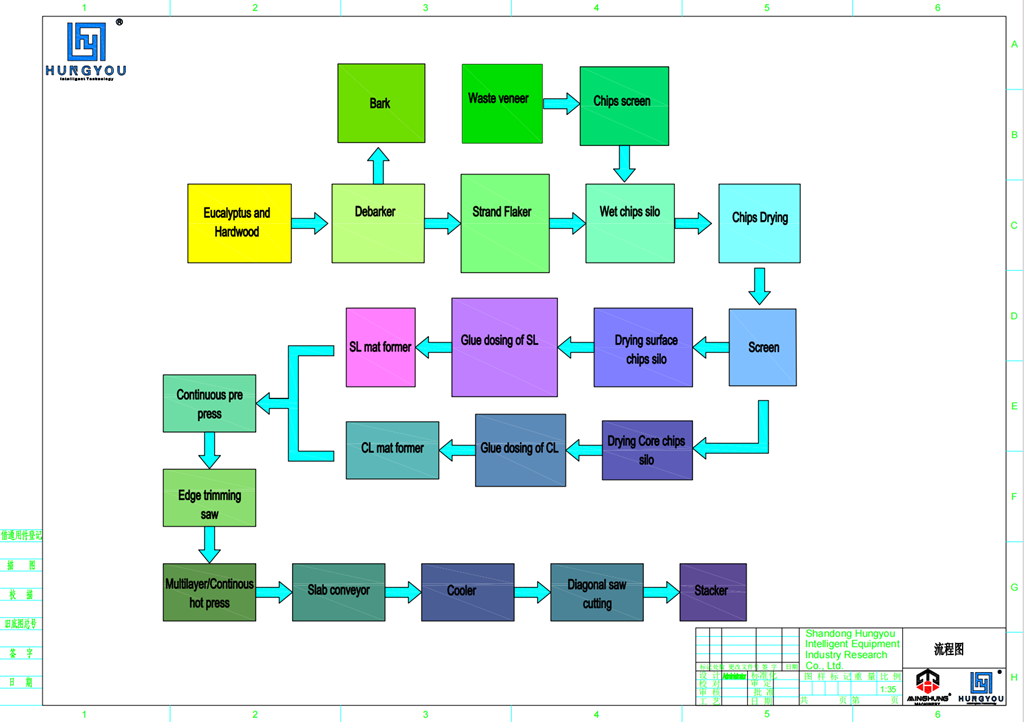
1. Clean Raw Material Preparation: Uses logs from sustainably managed forests (e.g., FSC/PEFC certified). After debarking and washing, a high-precision strander produces uniform strands, laying the foundation for efficient blending and low emissions.
2. Energy-Efficient Drying and Screening: Wet strands are dried in a high-efficiency, energy-saving rotary drum dryer, preferably heated by natural gas or a biomass boiler utilizing process waste (bark, dust). Dryer exhaust is cleaned through a multi-stage dust removal and heat recovery system, with waste heat being recycled. Dried strands are then precisely screened.
3. No-Added-Formaldehyde Blending: Screened strands are precisely mixed with No-Added-Formaldehyde MDI resin and eco-friendly additives in enclosed blenders. Equipped with solvent recovery or sealing systems to prevent VOC escape.
4. Oriented Forming: Oriented forming is conducted under negative pressure or enclosed conditions to minimize dust emission. The high-precision former ensures optimal structure and reduces material waste.
5. Continuous Hot Pressing with Low-Emission Curing: An advanced continuous flat-platen press is used, featuring uniform platen heating for low energy consumption. The press area has exhaust collection ports to capture minimal volatile emissions for centralized treatment.
6. Closed-Loop Cooling and Conditioning: Energy from the cooling process is partially recovered. Ventilation in the conditioning area is optimized for low energy use.
7. Precision Sanding and Dust Extraction: The wide-belt sander is connected to a centralized dust collection system. Sander dust is efficiently collected and conveyed to the boiler as fuel, achieving 100% recycling.
8. Intelligent Cutting and Grading: Online inspection systems (e.g., X-ray densitometer, NIR moisture meter) monitor quality in real-time, ensuring product consistency and reducing reject rates. Trim waste is automatically recycled.
9. Green Packaging and Marking: Uses recyclable or minimal packaging materials. An automatic marking system prints the environmental grade (e.g., CARB NAF, F★★★★) and traceability information.

II. Key Production Equipment List
The core of eco-certification lies not only in the process but in the hardware system equipped with dedicated environmental devices:
1. Raw Material Preparation Section:
Efficient debarker with wash water circulation system.
High-precision long-log strander/flaker.
2. Drying and Energy Section:
Low-NOx biomass/natural gas boiler and thermal energy plant.
Energy-saving dryer with multi-stage (cyclone + baghouse/wet electrostatic) dust removal and heat exchangers.
3. Blending and Forming Section:
Fully enclosed, No-Added-Formaldehyde MDI resin blending system with precise metering and cleaning functions.
High-precision mechanical/electrostatic oriented former with dust collection ports.
4. Pressing Section:
Continuous flat-platen press with efficient thermal oil system and exhaust collection ports.
5. Finishing and Environmental Treatment Section:
Powerful centralized dust collection system covering all dust generation points.
Wide-belt sander with pneumatic dust recovery system.
Waste (trim, sawdust) shredding, recycling, and automatic conveying system.
Low-noise fans and pumps with sound enclosures.
III. Core Advantages of the Production Line
The advantages of this line are reflected in four dimensions: "Compliance, Economy, Brand, and Future."
1. Market Access and Compliance Advantage:
Output panels directly meet the world's most stringent eco-standards (CARB NAF, EPA NAF, F★★★★, CE), providing a green passport to high-end markets in Europe, America, and Japan.
The production process itself complies with international environmental management systems (e.g., ISO 14001) and local emission regulations, avoiding environmental penalties and production stoppage risks.
2. Operational Cost and Economic Benefits:
Significantly Reduced Energy Costs: Waste-to-energy (using bark, dust as fuel) and heat recovery systems reduce dependence on external energy by over 30%.
Exceptionally High Material Utilization: Near-zero waste disposal; all process waste is internally recycled, directly lowering raw material costs.
Automation and Intelligence: Reduces labor, optimizes processes, increases yield, and lowers quality loss costs.
3. Product Competitiveness and Brand Value:
Produces genuine "No-Added-Formaldehyde" green panels, meeting the core consumer demand for healthy homes, allowing for premium pricing.
Strong backing from environmental certifications vastly enhances the manufacturer's corporate social image and brand credibility, serving as a powerful marketing tool.
4. Sustainability and Future Adaptability:
This is a future-proof investment. As global carbon taxes, emission trading, and environmental regulations tighten, this line offers long-term compliance and risk resilience.
Embodies the circular economy concept, aligns with global sustainable development trends, and facilitates access to government support or green financing.
Claim Your Free OSB Line Layout! Get end-to-end plant design from strand preparation to sanding. Receive 3D factory plan within 30 days.
Our contacts:
Whatsapp: +8618769900191 +8615589105786 +8618954906501
Email: osbmdfmachinery@gmail.com

I. Detailed Production Process
Building upon the standard OSB process, the eco-certified line deeply integrates energy-saving, emission reduction, pollution control, and resource recycling technologies, forming a green closed-loop process.
The core process is as follows:
1. Clean Raw Material Preparation: Uses logs from sustainably managed forests (e.g., FSC/PEFC certified). After debarking and washing, a high-precision strander produces uniform strands, laying the foundation for efficient blending and low emissions.
2. Energy-Efficient Drying and Screening: Wet strands are dried in a high-efficiency, energy-saving rotary drum dryer, preferably heated by natural gas or a biomass boiler utilizing process waste (bark, dust). Dryer exhaust is cleaned through a multi-stage dust removal and heat recovery system, with waste heat being recycled. Dried strands are then precisely screened.
3. No-Added-Formaldehyde Blending: Screened strands are precisely mixed with No-Added-Formaldehyde MDI resin and eco-friendly additives in enclosed blenders. Equipped with solvent recovery or sealing systems to prevent VOC escape.
4. Oriented Forming: Oriented forming is conducted under negative pressure or enclosed conditions to minimize dust emission. The high-precision former ensures optimal structure and reduces material waste.
5. Continuous Hot Pressing with Low-Emission Curing: An advanced continuous flat-platen press is used, featuring uniform platen heating for low energy consumption. The press area has exhaust collection ports to capture minimal volatile emissions for centralized treatment.
6. Closed-Loop Cooling and Conditioning: Energy from the cooling process is partially recovered. Ventilation in the conditioning area is optimized for low energy use.
7. Precision Sanding and Dust Extraction: The wide-belt sander is connected to a centralized dust collection system. Sander dust is efficiently collected and conveyed to the boiler as fuel, achieving 100% recycling.
8. Intelligent Cutting and Grading: Online inspection systems (e.g., X-ray densitometer, NIR moisture meter) monitor quality in real-time, ensuring product consistency and reducing reject rates. Trim waste is automatically recycled.
9. Green Packaging and Marking: Uses recyclable or minimal packaging materials. An automatic marking system prints the environmental grade (e.g., CARB NAF, F★★★★) and traceability information.


II. Key Production Equipment List
The core of eco-certification lies not only in the process but in the hardware system equipped with dedicated environmental devices:
1. Raw Material Preparation Section:
Efficient debarker with wash water circulation system.
High-precision long-log strander/flaker.
2. Drying and Energy Section:
Low-NOx biomass/natural gas boiler and thermal energy plant.
Energy-saving dryer with multi-stage (cyclone + baghouse/wet electrostatic) dust removal and heat exchangers.
3. Blending and Forming Section:
Fully enclosed, No-Added-Formaldehyde MDI resin blending system with precise metering and cleaning functions.
High-precision mechanical/electrostatic oriented former with dust collection ports.
4. Pressing Section:
Continuous flat-platen press with efficient thermal oil system and exhaust collection ports.
5. Finishing and Environmental Treatment Section:
Powerful centralized dust collection system covering all dust generation points.
Wide-belt sander with pneumatic dust recovery system.
Waste (trim, sawdust) shredding, recycling, and automatic conveying system.
Low-noise fans and pumps with sound enclosures.
III. Core Advantages of the Production Line
The advantages of this line are reflected in four dimensions: "Compliance, Economy, Brand, and Future."
1. Market Access and Compliance Advantage:
Output panels directly meet the world's most stringent eco-standards (CARB NAF, EPA NAF, F★★★★, CE), providing a green passport to high-end markets in Europe, America, and Japan.
The production process itself complies with international environmental management systems (e.g., ISO 14001) and local emission regulations, avoiding environmental penalties and production stoppage risks.
2. Operational Cost and Economic Benefits:
Significantly Reduced Energy Costs: Waste-to-energy (using bark, dust as fuel) and heat recovery systems reduce dependence on external energy by over 30%.
Exceptionally High Material Utilization: Near-zero waste disposal; all process waste is internally recycled, directly lowering raw material costs.
Automation and Intelligence: Reduces labor, optimizes processes, increases yield, and lowers quality loss costs.
3. Product Competitiveness and Brand Value:
Produces genuine "No-Added-Formaldehyde" green panels, meeting the core consumer demand for healthy homes, allowing for premium pricing.
Strong backing from environmental certifications vastly enhances the manufacturer's corporate social image and brand credibility, serving as a powerful marketing tool.
4. Sustainability and Future Adaptability:
This is a future-proof investment. As global carbon taxes, emission trading, and environmental regulations tighten, this line offers long-term compliance and risk resilience.
Embodies the circular economy concept, aligns with global sustainable development trends, and facilitates access to government support or green financing.
Claim Your Free OSB Line Layout! Get end-to-end plant design from strand preparation to sanding. Receive 3D factory plan within 30 days.
Our contacts:
Whatsapp: +8618769900191 +8615589105786 +8618954906501
Email: osbmdfmachinery@gmail.com