Views: 0 Author: Site Editor Publish Time: 21-09-2026 Origin: Site
Wood Preparation: The Foundation of Quality
Wood preparation is the critical preliminary phase of an mdf production line, where raw timber is processed into consistent chips, serving as the essential precursor for fiber generation.
The quality of the final board is inextricably linked to the initial raw material input. In an industrial mdf production line, the wood preparation section typically begins with log debarking to minimize impurities. Contaminants such as sand, bark, or stones can prematurely degrade the refining equipment and negatively impact the surface finish of the finished panel. Once the bark is removed, the logs are fed into industrial chippers designed to produce chips of a uniform size, which is vital for the subsequent uniform cooking and refining process.
Efficient wood preparation requires a robust screening system. The chips are screened to remove oversized pieces, which would require excessive energy during refining, and fines, which could cause inconsistent fiber distribution. Achieving a standardized chip morphology directly impacts the power consumption of the refiner and the ultimate density profile of the panel.
Furthermore, the storage and handling of these chips—often stored in large silos—must be managed to maintain a consistent moisture content. Fluctuations in moisture level can lead to variations in the steaming process, directly affecting the fiber quality. Our field observations indicate that facilities prioritizing automated moisture control systems in the wood preparation area demonstrate a 15 percent increase in overall panel strength consistency.
Parameter | Function | Importance |
Chipper Type | Size Reduction | Determines fiber length consistency |
Screen Mesh Size | Particle Sorting | Prevents oversized material clogs |
Metal Detection | Damage Prevention | Protects downstream refiner discs |
Moisture Content | Pre-treatment Stability | Ensures uniform fiber cooking |
Fiber preparation is the core chemical-mechanical transformation process where wood chips are softened via steam and mechanically fiberized to create the basic building block of MDF.
This process takes place within the pressurized refining unit. The chips are first pre-heated in a steaming vessel, which softens the lignin, the natural adhesive within the wood structure. Once softened, the chips move into the refiner, a high-torque machine that utilizes rotating plates to mechanically separate the wood into individual fibers. This step defines the quality of the surface of the final MDF board. If the fiber is too coarse, the board surface becomes porous; if it is over-refined, the energy expenditure becomes uneconomical and the resulting board may lack the required internal bond strength.
From a technical perspective, the control of the steam pressure within the digester and the gap precision between the refiner plates are paramount. This stage is where we begin to see the difference between low-grade and high-grade panel production. For those interested in the intricacies of these mechanical transitions, this comprehensive guide to the mdf manufacturing process provides essential context on how fiber morphology dictates the ultimate mechanical properties of the panel.
Engineering the wood matrix also involves the removal of air and excess water from the fiber after it leaves the refiner. The fiber is then accelerated through a blow line, where it is treated with resins. In this phase, the expertise of the line operator in maintaining the pressure balance is vital. The fiber must be uniformly distributed in the dryer to ensure that no clumping occurs, which would otherwise lead to "resin spots" on the surface of the finished board.
Digester: Pressurized vessel for chip softening.
Refiner: The mechanical heart; high-speed plate system for separation.
Blow Line: Transports fiber from refiner to dryer while injecting additives.
Tube Dryer: Reduces fiber moisture to the levels required for mat formation.
Refining Maintenance: High-precision refiner plates must be inspected weekly. Small variations in plate wear can lead to significant energy spikes and inconsistent fiber density, directly affecting the panel's internal bond and surface smoothness.
Resin and additive application is the phase in an mdf production line where the mechanical fiber is transformed into a bondable substrate through the precise injection of binding agents.
The chemistry used here is largely dictated by the application of the board—whether it is intended for moisture-resistant furniture, interior decor, or structural applications. Urea-formaldehyde (UF) resin is the most common binder, though for high-end moisture-resistant boards, Melamine-Urea-Formaldehyde (MUF) or other specialty resins are preferred. The application occurs usually in the blow line, immediately after the refiner, ensuring that the resin is atomized and evenly distributed across the surface of the individual fibers before the fiber enters the dryer.
The interaction between the fiber and the resin is not merely mechanical; it is a complex chemical equilibrium. Our industry experience shows that the atomization pressure is the most critical variable. If the pressure is too low, resin distribution is patchy, resulting in localized weak points in the panel. If it is too high, there is a risk of excessive resin consumption, which increases the production cost significantly without a commensurate increase in panel strength. Manufacturers today often employ automated viscosity control systems to ensure that the resin remains consistent despite variations in ambient temperature and humidity within the plant.
Wax is also introduced during this phase, primarily to improve the moisture resistance of the board. It is generally applied in an emulsion form. The key to successful wax application is the timing; it must be introduced in a way that allows it to coat the fiber surface without interfering with the bonding efficacy of the resin. The correct balance of resin, hardeners, and wax is what allows the mdf production line to produce boards that meet stringent international emission standards like E1, E0, or CARB P2.
Forming and hot pressing represent the final assembly phase, where the resin-coated fibers are mechanically laid into a continuous mat and cured under high pressure and temperature to produce the final panel.
The forming station is responsible for the uniformity of the fiber mat. A sophisticated spreader system is employed to ensure that the fiber is distributed evenly across the belt. Any deviation in density during the forming phase—such as uneven thickness or localized fiber clumps—will result in defective panels during the pressing phase. Modern lines use laser-based density monitoring to make real-time adjustments to the spreading mechanism, ensuring the mat is as homogeneous as possible before it enters the hot press.
The hot press is arguably the most significant investment in the entire mdf production line. Today, the industry standard has shifted almost exclusively toward the continuous hot press. Unlike older multi-opening presses, the continuous press allows for a constant production speed and a more stable thickness profile. By applying pressure and heat in a continuous, controlled manner, the press ensures that the resin cures evenly throughout the board, preventing the issues of surface blistering or internal bubbles that often plagued older batch-processing methods.
For clients looking to maximize their yield and panel quality, the selection of the continuous hot press system is the primary strategic decision. The ability of these systems to ramp up temperature rapidly and maintain pressure accurately allows for the production of high-density boards (HDF) and thinner panels that were previously difficult to manufacture at scale.
Component | Function | Operating Focus |
Forming Station | Fiber mat distribution | Uniform thickness & density |
Pre-Press | Initial mat compaction | Removes air for easier pressing |
Continuous Hot Press | Thermal & pressure curing | Precise temperature and gap control |
Thickness Measurement | Real-time quality check | Minimizes material waste |
Finishing and handling in an mdf production line encompass the essential post-pressing steps, including cooling, trimming, sanding, and storage, which bring the boards to their final commercial specifications.
Once the boards exit the hot press, they are essentially raw, oversized panels. They must first be cooled, typically in a star-shaped cooler, to allow for the stabilization of the board’s internal chemistry and temperature. If the boards are stacked while still too hot, they risk deformation, often referred to in the industry as "cupping" or "bowing." Following the cooling process, the boards are trimmed to their final width and length. This is a critical stage for waste management; optimizing the cutting pattern can lead to significant savings in raw material utilization.
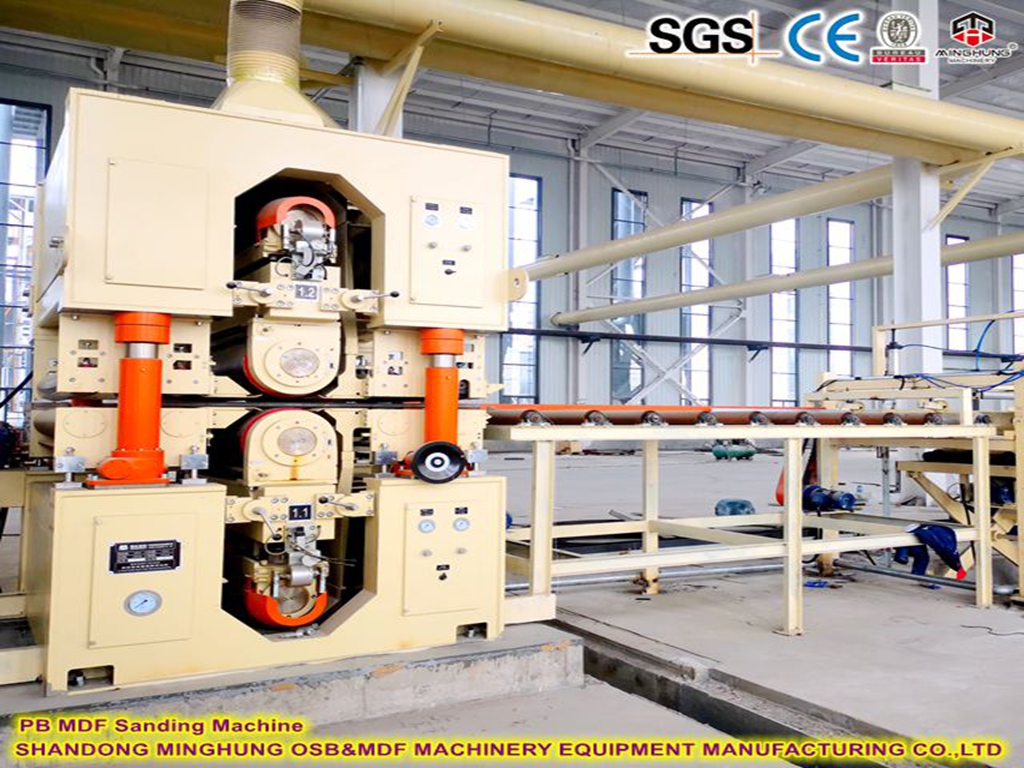
Sanding is the final major mechanical step. It is necessary to remove any surface irregularities and to bring the board to its exact commercial thickness. A high-quality sanding line uses progressively finer belts to ensure a smooth, uniform surface that is ready for lamination or painting. For clients serving the high-end cabinetry market, the precision of the sanding operation is often the single most important factor in customer satisfaction.
Finally, the handling section includes the automated stacking and packing line. A well-organized mdf production line integrates these systems directly with the digital inventory tracking software. This allows for seamless transitions from the press to the shipping warehouse, ensuring that the product is tracked and managed efficiently. By investing in an integrated continuous hot press and automated finishing solution, operators can significantly reduce human intervention and minimize the risks of manual handling errors.
In summary, an mdf production line is a complex, integrated system where every stage—from wood preparation to final sanding—requires meticulous control and coordination. The shift toward more advanced, continuous technologies has significantly improved the quality and consistency of MDF products, making them an indispensable material in modern construction and furniture manufacturing. For any operator, the key to success lies in understanding the core components and their interplay. By prioritizing precision in the forming process, maintaining the stability of the refining phase, and utilizing the most modern continuous hot-pressing technology, manufacturers can ensure a highly competitive and profitable production environment. We must always remember that the goal is not just the production of panels, but the creation of a consistent, high-quality, and versatile material that meets the evolving demands of our global market.