| Availability: | |
|---|---|
MH-PB
MINGHUNG
Core Design Philosophy
The Silent & Eco-Friendly Particleboard Production Line is a modern industrial solution built upon traditional high-efficiency lines, deeply integrating industrial noise control technology and full-process clean production standards. Its design aims to create a manufacturing system capable of high-output, stable operation while harmoniously coexisting with modern green industrial parks and environmentally sensitive communities. It helps clients transform the concept of "green manufacturing" into a core competitive advantage.
|
Main Workflow
While maintaining standard processes, this line incorporates noise reduction and environmental considerations at every stage:
1. Raw Material Preprocessing (Quiet Start-up): The raw material yard layout is optimized to minimize internal transport distance and noise. Equipment like chippers are housed within acoustic enclosures, and hydraulic drive systems are employed for quieter start-up, reducing impact noise.
2. Drying & Classification (Containment & Purification): The drying system features fully enclosed ductwork with flexible seals at connections to prevent air and noise leaks. Exhaust gases undergo multi-stage dust removal and heat recovery before entering final treatment equipment like RTOs (Regenerative Thermal Oxidizers), ensuring VOC emissions compliance.
3. Blending & Forming (Precision & Low Waste): The central glue application system uses high-precision metering to reduce adhesive waste and subsequent volatiles. The forming chamber is acoustically treated with sound-absorbing materials internally to minimize high-frequency noise from mechanical forming.
4. Hot Pressing (Core Noise Reduction & Energy Saving): As a primary vibration source, the hot press is installed on a massive, independent vibration-damping foundation to effectively isolate structure-borne noise. The hydraulic system uses variable displacement pumps and silent valve blocks, drastically reducing hydraulic noise. Simultaneously, press heat is efficiently recovered via a closed-loop system.
5. Post-Pressing & Cutting (Source Control): Cooling, cutting, and sanding areas are designed as separated, sound-insulated cabins. Cutting equipment is fitted with silencing saw hoods and damping mounts. Sanders are connected to a highly efficient central dust extraction system, ensuring low dust and noise levels in the working environment.
6. Full-Line Intelligent Monitoring: Online sensors for noise, dust, and VOCs installed at the plant boundary and key equipment feed real-time data to the central control room, enabling transparent and traceable management of environmental performance.

|
List of Main Production Equipment
A complete particleboard production line is a Complex systems engineering,comprising specialized equipment from multiple sections connected in series. Below is a detailed introduction to its main production equipment:
I. Raw Material Preparation Section
1. Chipper: Processes logs, wood scraps, and similar materials into wood chips of uniform size.

2. Flaker:Further processes wood chips into thin, uniform flakes (primarily used for surface-layer material).

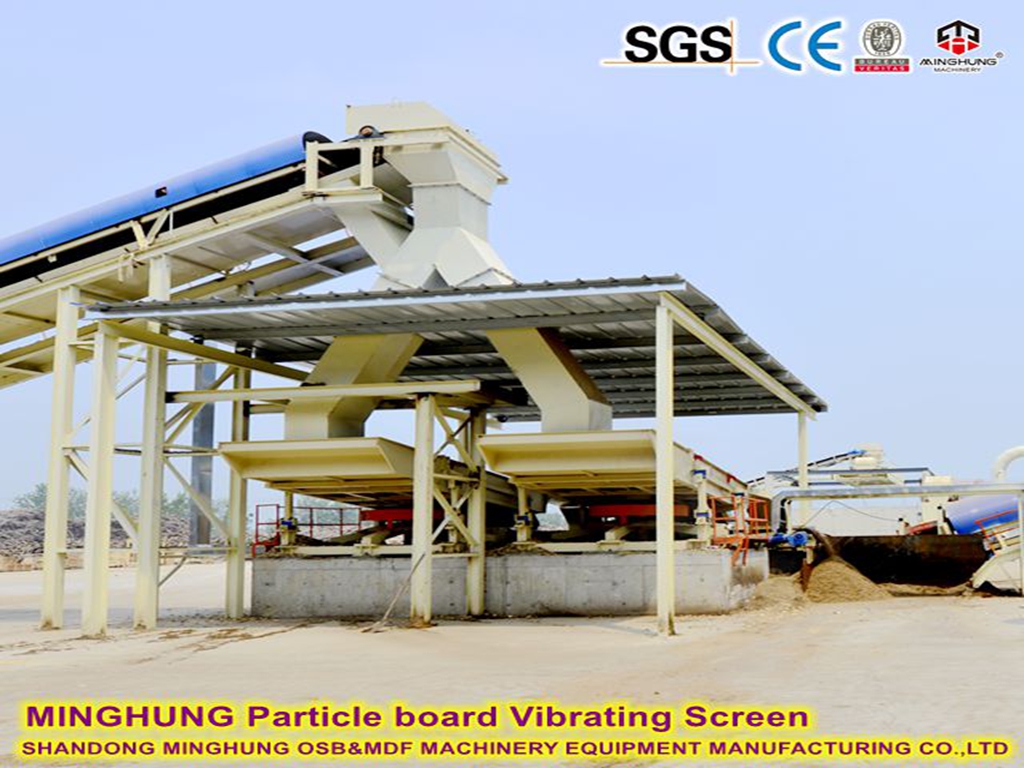
3. Screening Machine(Vibration Screen or Swing Screen): Classifies flakes by size. Oversized flakes are sent back for refining, qualified flakes are sent to surface and core layer storage bins, and fine dust is collected for disposal.

II. Drying and Classification Section
This section controls the moisture content of the flakes and sorts them.
4. Rotary Drum Dryer: The most common drying equipment. It efficiently dries flakes using a rotating drum and hot air (or flue gas) to reduce moisture content to process requirements (typically 1-3%).

III. Blending and Additive Section
5.Blender (Ring Blender): Core equipment. Flakes are thoroughly mixed inside the high-speed rotating blender with atomized adhesive, wax (water repellent), and other additives sprayed in.

IV. Mat Forming and Pre-pressing Section
6. Former:
Mechanical Former: Uses the mechanical action of flinging rolls and leveling rolls to form a graduated mat (fine surface layer, coarse core layer) from resinated flakes.
Pneumatic Former: Uses airflow for forming, offering higher precision, especially suitable for producing thin boards with high surface quality requirements.

7. Pre-press: Applies initial compression to the loose mat to increase strength for transport into the press and remove some air.

V. Hot Pressing (Curing) Section
8. Hot Press (Core of the production line):
Multi-Opening Hot Press:Equipped with a simultaneous closing system and loading/unloading system, suitable for multi-format, flexible production.

Continuous Press: The mat passes continuously between two heated steel belts where it is pressed and cured. High output, minimal thickness tolerance, low energy consumption. Suitable for large-scale, single-format production.

9. Hydraulic System: Provides powerful, stable pressure for the press, including oil pumps, valve blocks, accumulators, etc.

VI. Post-pressing and Finishing Section
10. Cooler and Board Turner: Ensures uniform and rapid cooling of the hot-pressed board to release stress and prevent warping.

11. Cross-cut and Trim Saw System: Includes intermediate saws, cross-cut saws, and edge trimmers to cut the green board into required final dimensions.

12. Sanding Machine: Multi-head (typically 4-8 heads) wide-belt sander for calibrating thickness and surface finishing of the boards.

VII. Auxiliary and Support Systems
13. Central Control System: PLC and Industrial PC-based automation control system monitoring the entire line.

14. Energy Center: May include boilers, heat recovery units (e.g., for dryer exhaust), providing thermal energy for drying and pressing.

Characteristics of a Standard Production Line: The equipment configuration is centered on meeting the basic needs of stable, continuous, and large-scale production, emphasizing reliability and cost-effectiveness. It is the most widely used basic configuration in the industry. Advanced modules for customization, high stability, or environmental quietness can be added on top of this base configuration as needed.
|
Core Advantages and Value Proposition
1. Exceptional Acoustic Performance: Achieves leading noise levels of ≤60 dB(A) during daytime and ≤50 dB(A) at night at the plant boundary, meeting the strictest requirements for sites near residential areas and significantly improving worker occupational health.
2. Comprehensive Environmental Compliance: Full-process emissions (dust, VOCs, wastewater) not only meet Chinese national standards but can easily achieve stringent international standards like those in the EU and North America, smoothing the path for product export.
3. Significant Operational Cost Savings:
Energy Saving: Heat recovery systems can reduce overall thermal energy consumption by 15%-25%.
Material Saving: High-precision control systems minimize raw material and adhesive waste.
Low Maintenance: A clean operating environment reduces equipment wear and failure rates.
4. Enhanced Brand Image: A "Silent & Eco-Friendly Factory" is the ultimate testament to corporate social responsibility and advanced manufacturing capability. It significantly boosts brand reputation and directly serves clients with stringent environmental demands, such as high-end furniture brands and green building projects.
5. Future-Proof Adaptability: Proactively addresses globally tightening environmental regulations, avoiding future production stoppages or massive retrofit investments due to compliance upgrades, thereby protecting long-term asset value.
|
Finished Product Applications & Market Positioning
The boards produced by this line, with their "green DNA," are particularly suited for markets with the highest demands for environmental and health standards:
High-End Custom Furniture & Cabinetry: Meets the eco-certification requirements of domestic and international premium brands.
Interior Finishing & Children's Room Specialty Boards: Aligns with market demand for no-added-formaldehyde and low-odor products.
Factories with Special Location Requirements: Ideal for production sites located within ecological parks, high-tech zones, or adjacent to residential areas.
|
Product Packaging
|
Our Services
Production Line Planning & Design: Customized solution based on customer's site and raw material conditions
Equipment Installation & Commissioning: Dispatch engineer teams for on-site installation and production commissioning
Personnel Training: Theoretical + hands-on training until mastery
|
Company Profile
We are Shandong MINGHUNG Wood Based Panel Machinery Co.,Ltd China factory and manufacturer of full sets of Plywood machinery and Veneer machinery. With many years production experience, advanced production technology,experienced workers and professional engineers, we can offer you the suitable, good and strong machinery for you.
|
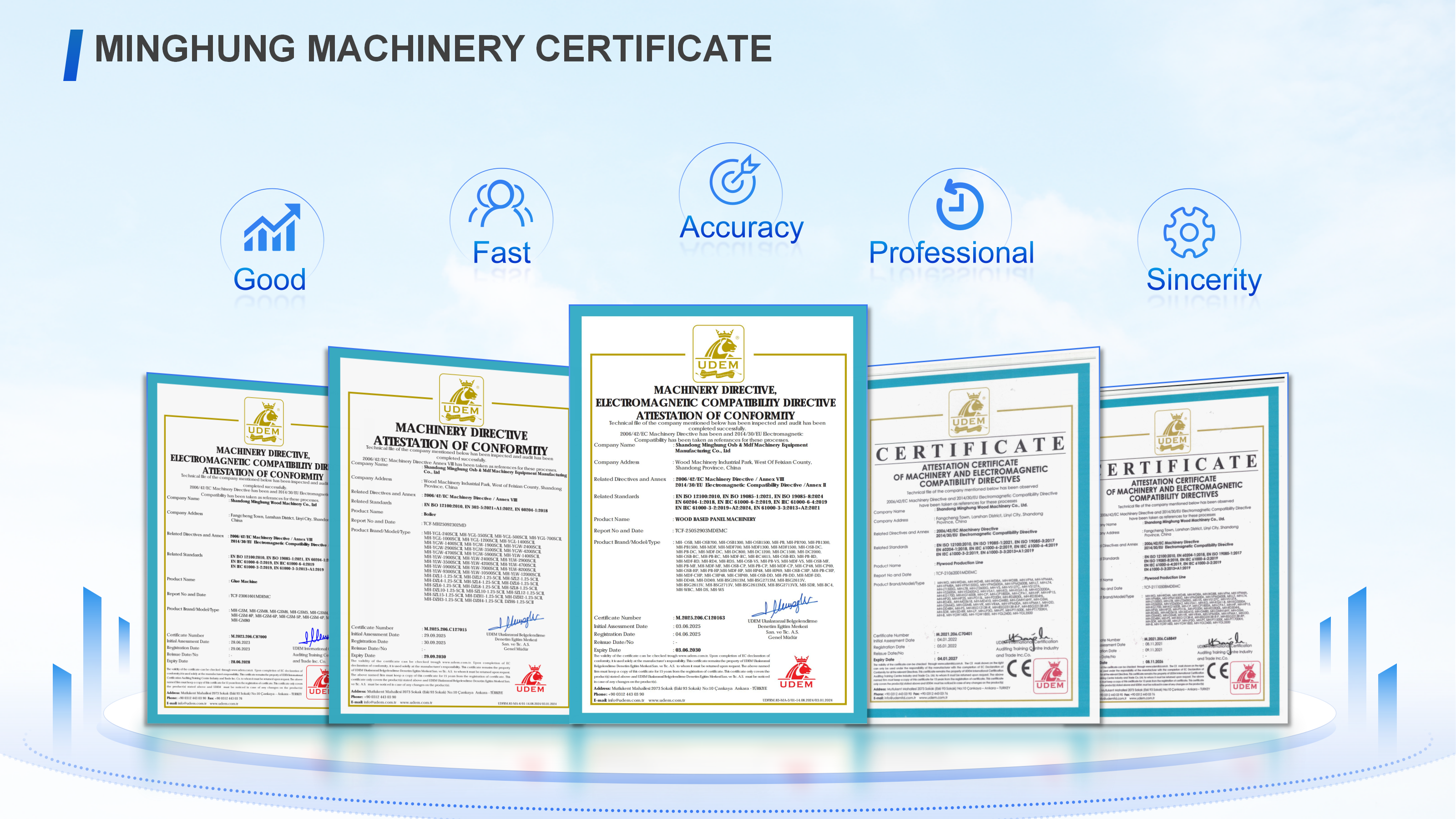
Certifications
|
Customer Photos
Contact us for a free quote today!
Our contacts:
Whatsapp: +8618769900191 +8615589105786 +8618954906501
Email: osbmdfmachinery@gmail.com
Core Design Philosophy
The Silent & Eco-Friendly Particleboard Production Line is a modern industrial solution built upon traditional high-efficiency lines, deeply integrating industrial noise control technology and full-process clean production standards. Its design aims to create a manufacturing system capable of high-output, stable operation while harmoniously coexisting with modern green industrial parks and environmentally sensitive communities. It helps clients transform the concept of "green manufacturing" into a core competitive advantage.
|
Main Workflow
While maintaining standard processes, this line incorporates noise reduction and environmental considerations at every stage:
1. Raw Material Preprocessing (Quiet Start-up): The raw material yard layout is optimized to minimize internal transport distance and noise. Equipment like chippers are housed within acoustic enclosures, and hydraulic drive systems are employed for quieter start-up, reducing impact noise.
2. Drying & Classification (Containment & Purification): The drying system features fully enclosed ductwork with flexible seals at connections to prevent air and noise leaks. Exhaust gases undergo multi-stage dust removal and heat recovery before entering final treatment equipment like RTOs (Regenerative Thermal Oxidizers), ensuring VOC emissions compliance.
3. Blending & Forming (Precision & Low Waste): The central glue application system uses high-precision metering to reduce adhesive waste and subsequent volatiles. The forming chamber is acoustically treated with sound-absorbing materials internally to minimize high-frequency noise from mechanical forming.
4. Hot Pressing (Core Noise Reduction & Energy Saving): As a primary vibration source, the hot press is installed on a massive, independent vibration-damping foundation to effectively isolate structure-borne noise. The hydraulic system uses variable displacement pumps and silent valve blocks, drastically reducing hydraulic noise. Simultaneously, press heat is efficiently recovered via a closed-loop system.
5. Post-Pressing & Cutting (Source Control): Cooling, cutting, and sanding areas are designed as separated, sound-insulated cabins. Cutting equipment is fitted with silencing saw hoods and damping mounts. Sanders are connected to a highly efficient central dust extraction system, ensuring low dust and noise levels in the working environment.
6. Full-Line Intelligent Monitoring: Online sensors for noise, dust, and VOCs installed at the plant boundary and key equipment feed real-time data to the central control room, enabling transparent and traceable management of environmental performance.

|
List of Main Production Equipment
A complete particleboard production line is a Complex systems engineering,comprising specialized equipment from multiple sections connected in series. Below is a detailed introduction to its main production equipment:
I. Raw Material Preparation Section
1. Chipper: Processes logs, wood scraps, and similar materials into wood chips of uniform size.

2. Flaker:Further processes wood chips into thin, uniform flakes (primarily used for surface-layer material).

3. Screening Machine(Vibration Screen or Swing Screen): Classifies flakes by size. Oversized flakes are sent back for refining, qualified flakes are sent to surface and core layer storage bins, and fine dust is collected for disposal.

II. Drying and Classification Section
This section controls the moisture content of the flakes and sorts them.
4. Rotary Drum Dryer: The most common drying equipment. It efficiently dries flakes using a rotating drum and hot air (or flue gas) to reduce moisture content to process requirements (typically 1-3%).

III. Blending and Additive Section
5.Blender (Ring Blender): Core equipment. Flakes are thoroughly mixed inside the high-speed rotating blender with atomized adhesive, wax (water repellent), and other additives sprayed in.

IV. Mat Forming and Pre-pressing Section
6. Former:
Mechanical Former: Uses the mechanical action of flinging rolls and leveling rolls to form a graduated mat (fine surface layer, coarse core layer) from resinated flakes.
Pneumatic Former: Uses airflow for forming, offering higher precision, especially suitable for producing thin boards with high surface quality requirements.

7. Pre-press: Applies initial compression to the loose mat to increase strength for transport into the press and remove some air.

V. Hot Pressing (Curing) Section
8. Hot Press (Core of the production line):
Multi-Opening Hot Press:Equipped with a simultaneous closing system and loading/unloading system, suitable for multi-format, flexible production.

Continuous Press: The mat passes continuously between two heated steel belts where it is pressed and cured. High output, minimal thickness tolerance, low energy consumption. Suitable for large-scale, single-format production.

9. Hydraulic System: Provides powerful, stable pressure for the press, including oil pumps, valve blocks, accumulators, etc.

VI. Post-pressing and Finishing Section
10. Cooler and Board Turner: Ensures uniform and rapid cooling of the hot-pressed board to release stress and prevent warping.

11. Cross-cut and Trim Saw System: Includes intermediate saws, cross-cut saws, and edge trimmers to cut the green board into required final dimensions.

12. Sanding Machine: Multi-head (typically 4-8 heads) wide-belt sander for calibrating thickness and surface finishing of the boards.

VII. Auxiliary and Support Systems
13. Central Control System: PLC and Industrial PC-based automation control system monitoring the entire line.

14. Energy Center: May include boilers, heat recovery units (e.g., for dryer exhaust), providing thermal energy for drying and pressing.

Characteristics of a Standard Production Line: The equipment configuration is centered on meeting the basic needs of stable, continuous, and large-scale production, emphasizing reliability and cost-effectiveness. It is the most widely used basic configuration in the industry. Advanced modules for customization, high stability, or environmental quietness can be added on top of this base configuration as needed.
|
Core Advantages and Value Proposition
1. Exceptional Acoustic Performance: Achieves leading noise levels of ≤60 dB(A) during daytime and ≤50 dB(A) at night at the plant boundary, meeting the strictest requirements for sites near residential areas and significantly improving worker occupational health.
2. Comprehensive Environmental Compliance: Full-process emissions (dust, VOCs, wastewater) not only meet Chinese national standards but can easily achieve stringent international standards like those in the EU and North America, smoothing the path for product export.
3. Significant Operational Cost Savings:
Energy Saving: Heat recovery systems can reduce overall thermal energy consumption by 15%-25%.
Material Saving: High-precision control systems minimize raw material and adhesive waste.
Low Maintenance: A clean operating environment reduces equipment wear and failure rates.
4. Enhanced Brand Image: A "Silent & Eco-Friendly Factory" is the ultimate testament to corporate social responsibility and advanced manufacturing capability. It significantly boosts brand reputation and directly serves clients with stringent environmental demands, such as high-end furniture brands and green building projects.
5. Future-Proof Adaptability: Proactively addresses globally tightening environmental regulations, avoiding future production stoppages or massive retrofit investments due to compliance upgrades, thereby protecting long-term asset value.
|
Finished Product Applications & Market Positioning
The boards produced by this line, with their "green DNA," are particularly suited for markets with the highest demands for environmental and health standards:
High-End Custom Furniture & Cabinetry: Meets the eco-certification requirements of domestic and international premium brands.
Interior Finishing & Children's Room Specialty Boards: Aligns with market demand for no-added-formaldehyde and low-odor products.
Factories with Special Location Requirements: Ideal for production sites located within ecological parks, high-tech zones, or adjacent to residential areas.
|
Product Packaging
|
Our Services
Production Line Planning & Design: Customized solution based on customer's site and raw material conditions
Equipment Installation & Commissioning: Dispatch engineer teams for on-site installation and production commissioning
Personnel Training: Theoretical + hands-on training until mastery
|
Company Profile
We are Shandong MINGHUNG Wood Based Panel Machinery Co.,Ltd China factory and manufacturer of full sets of Plywood machinery and Veneer machinery. With many years production experience, advanced production technology,experienced workers and professional engineers, we can offer you the suitable, good and strong machinery for you.
|
Certifications
|
Customer Photos
Contact us for a free quote today!
Our contacts:
Whatsapp: +8618769900191 +8615589105786 +8618954906501
Email: osbmdfmachinery@gmail.com