| Availability: | |
|---|---|
MH-PB
MINGHUNG

What is the Startup & Entry-Level Particleboard Production Line?
This production line is specifically designed for startups and small-scale investors. Its core philosophy is not to pursue ultimate automation and massive capacity, but to achieve "from zero to one, stable production, quick return on investment, and reserved upgrade potential." It serves as a foundational stepping stone to help entrepreneurs enter the industry with minimal risk.
What is the Production Line Specifically Like?
A typical entry-level line can be seen as a "streamlined and efficient version" of a large line. It retains the most essential processes but optimizes costs in automation.
1. Raw Material Section: Focus on Practicality
Crusher/Hammer Mill: Essential equipment for processing wood waste into qualified particles.
Dryer: Usually a small or medium-sized rotary drum dryer to ensure particle moisture content meets standards.
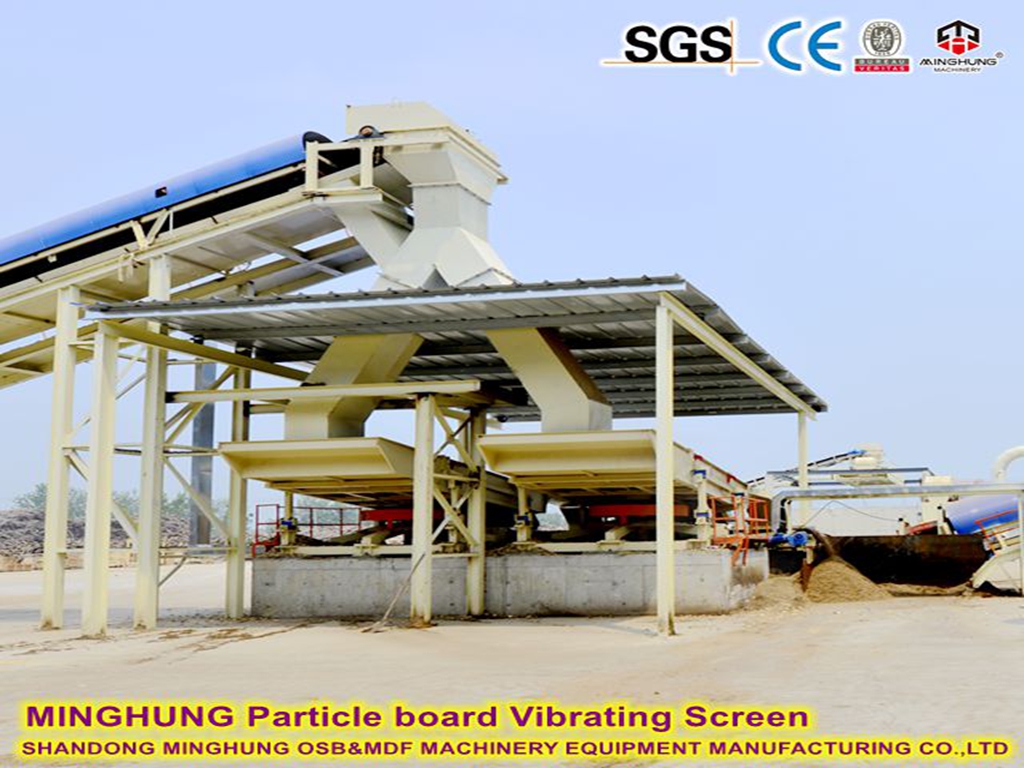
Simple Screening: May use vibrating screens instead of complex air classification for basic surface/core layer separation.
Blender: Core equipment to ensure uniform mixing of resin and particles.
dryer machine
vibrating screen
gluing machine
2. Forming & Pressing Section: The Core
Forming Station: Likely a mechanical former, meeting basic forming needs with sufficient mat quality.
Core Equipment - Multi-Opening Hot Press: This is the signature choice for an entry-level line. Compared to expensive continuous presses, multi-opening presses are low-cost, sturdy, and easy to maintain. Although production is batch-based (pressing one load at a time), it is fully adequate for a startup.
mat forming machine
multilayer hot press
3. Post-Press Section: Manually Assisted Automation
Loading/Unloading System: Works with the multi-opening press to automatically feed and unload the mats; key for safety and efficiency.
Cooling & Cutting: Will have a cooling frame and trim saws, but panel transfer and positioning may rely more on manual labor or simple conveyors.
Sander: Will include a basic sander, though it might not be a full-width calibrating sander, with lower capacity and automation levels.
dryer rack
cross-cut saw
sanding machine
4. Stacking & Packaging Section: Key Area for Cost Control
This is where manual involvement is highest.
Automatic stackers might be omitted, replaced by manual-assisted stacking stations where workers manually place stickers and arrange the stacks.
Packaging might also be done by workers using hand-held stretch wrap machines.
Core Value & Advantages for Startups
1. Very Low Entry Barrier: Enables entrepreneurs with limited capital to enter the particleboard manufacturing sector, turning ideas into reality.
2. Quick Return on Investment (ROI): Due to the small initial investment, the payback period is relatively short once the line runs stably and sales channels are established.
3. High Flexibility: Ideal for handling small-batch, customized orders, allowing quick response to specific local market demands, which is difficult for large factories.
4. Controllable Operating Costs: Energy consumption, maintenance, and labor costs are far lower than those of fully automatic lines.
5. Valuable Learning Platform: Entrepreneurs can deeply understand the entire production process, manage teams, and develop markets by operating this relatively simple line, accumulating invaluable experience for future expansion.
6. Reserved Upgrade Path: Good designs incorporate a modular concept. As the company accumulates capital and market share, it can gradually upgrade – for instance, first adding an automatic stacker, or upgrading the former, eventually replacing the core press when conditions are ripe for a capacity leap.
In summary, the startup and entry-level particleboard production line is not a "watered-down" inferior product, but a "precisely positioned" strategic tool. It deeply understands the core pain points at the startup stage: capital, risk, and flexibility. It does not pursue technical sophistication but focuses on business feasibility and sustainability, serving as a solid runway for entrepreneurs to get their dreams off the ground.

Particleboard Production Process
The particleboard production process is a continuous industrial operation. Its core principle is to mix wood fragments (particles/flakes) with resin adhesive and press them into panels under heat and pressure. It can be divided into the following six core steps:
Step 1: Raw Material Preparation
Wood Preparation: Logs are debarked using a debarker.
Chipping and Flaking: The wood is fed into a chipper to produce small wood chips. These chips are then processed in a flaker to be broken down into finer, specified-sized flakes/particles.
Step 2: Drying and Screening
Drying: The wet particles are fed into a rotary drum dryer, where hot gases reduce their moisture content from high levels (e.g., 30%-50%) to the required range (typically 3%-5%). This is crucial for ensuring the quality of subsequent resin blending and pressing.
Screening: The dried particles are passed through vibrating screens or air classifiers to be separated into fine surface-layer particles and coarse core-layer particles. This is done to achieve a smoother surface and a stronger internal structure in the final board.
Step 3: Resin Blending and Additive Mixing
Resin Application: The screened particles are fed into a ring blender or high-speed mixer.
Mixing: During mixing, resin adhesive (most commonly Urea-Formaldehyde), a waterproofing agent (wax emulsion), and other additives (e.g., hardener) are uniformly sprayed onto the particles and thoroughly blended. This step determines the board's environmental class (e.g., E0, E1) and physical properties (e.g., moisture resistance).
Step 4: Mat Forming and Pre-pressing
Forming: The resinated particles are fed into a forming station. Modern formers typically use mechanical or air-assisted systems, following the "fine-coarse-fine" three-layer or multi-layer principle to spread a uniform, symmetrical mat on a moving steel belt. This ensures uniform density, structural stability, and reduced warping in the finished panel.
Pre-pressing: The loose, formed mat then enters a pre-press, where it is preliminary compacted at room temperature into a "mat band" with sufficient strength for transport and reduced thickness, preparing it for entry into the hot press.
Step 5: Hot Pressing and Curing
Hot Pressing: This is the most critical step in the entire process. The pre-pressed mat is fed into a hot press (modern large-scale lines predominantly use continuous presses, while smaller lines use multi-opening presses).
Curing: Inside the press, the mat is subjected to high temperature (typically 180-220°C) and high pressure. This causes the internal resin to melt and cure rapidly, firmly bonding the loose particles together to form a panel with high strength and specified density.
Step 6: Post-Press Processing
Cooling and Conditioning: The boards exiting the hot press are very hot and must be cooled using a cooler turner. Subsequently, the boards need to rest in a conditioning area for 24-72 hours to release internal stresses, balance moisture content, and stabilize their physical properties.
Cutting and Sanding: The conditioned boards are first trimmed to standard market dimensions (e.g., 1220x2440mm) by cross-cut and trim saws. Then, the boards enter a wide-belt sander for calibrating sanding, which removes the pre-cured surface layer and ensures precise, consistent thickness and a smooth, flat surface, ready for subsequent lamination or direct sale.
(Optional) Automatic Stacking and Packaging: In modern production lines, the sanded finished boards are neatly stacked by automatic stackers, with stickers placed between layers. Finally, the stacks are wrapped in plastic film, reinforced, and labeled by automatic packaging machines, becoming finished products ready for warehousing or shipment.

Key Parameters
1. Product Specifications
Parameter | Typical Range | Explanation |
Annual Capacity | 10,000 - 50,000 cubic meters | Core parameter.Significantly lower than large lines (hundreds of thousands), meeting regional market demand with manageable investment risk. |
Daily Output | Approx. 30 - 150 cubic meters | Calculated based on 300 working days per year. |
Board Density | 600 - 750 kg/cubic meter | Capable of producing medium to high-density boards, covering most furniture and decoration applications. |
Basic Board Size | 1220mm x 2440mm (4' x 8') | The most universal market standard size. |
Board Thickness Range | 8mm - 40mm | Can produce common specifications from thin to thick boards. Manual adjustment is required for thickness changes. |
Operating Schedule | 1-2 shifts | Typically does not require 24/7 continuous operation; production can be scheduled based on orders. |
2. Core Equipment Configuration
Parameter | Typical Configuration | Explanation |
Hot Press Type | Multi-Opening Hot Press | The hallmark of an entry-level line. Investment cost is much lower than a continuous press. Commonly 8-15 openings. |
Press Size | 4' x 8' or 4' x 16' | Matches the target product specifications. |
Forming Method | Mechanical Forming Station | Cost-effective, capable of meeting basic "fine-coarse-fine" three-layer structure requirements. |
Automation Level | Semi-Automatic | Key differentiator. Processes like raw material feeding and mat handling may require manual assistance. Stacking and packaging are primarily manual. |
Control System | PLC + Basic HMI | Enables automated control of core processes, ensuring basic process stability with a low technical barrier for operation. |
3. Cost Estimation
Parameter | Typical Range | Explanation |
Installation & Commissioning | 3 - 6 months | Fast timeline from equipment arrival to first board production, enabling quick market entry. |
Raw Material Requirements | Wood waste (shavings, sawdust, small-diameter logs, etc.) | Widely available, low cost. |
Resin Type | Urea-Formaldehyde (UF) | Most common, lowest cost. More expensive modified resins are needed for E0 grade or moisture-resistant boards. |
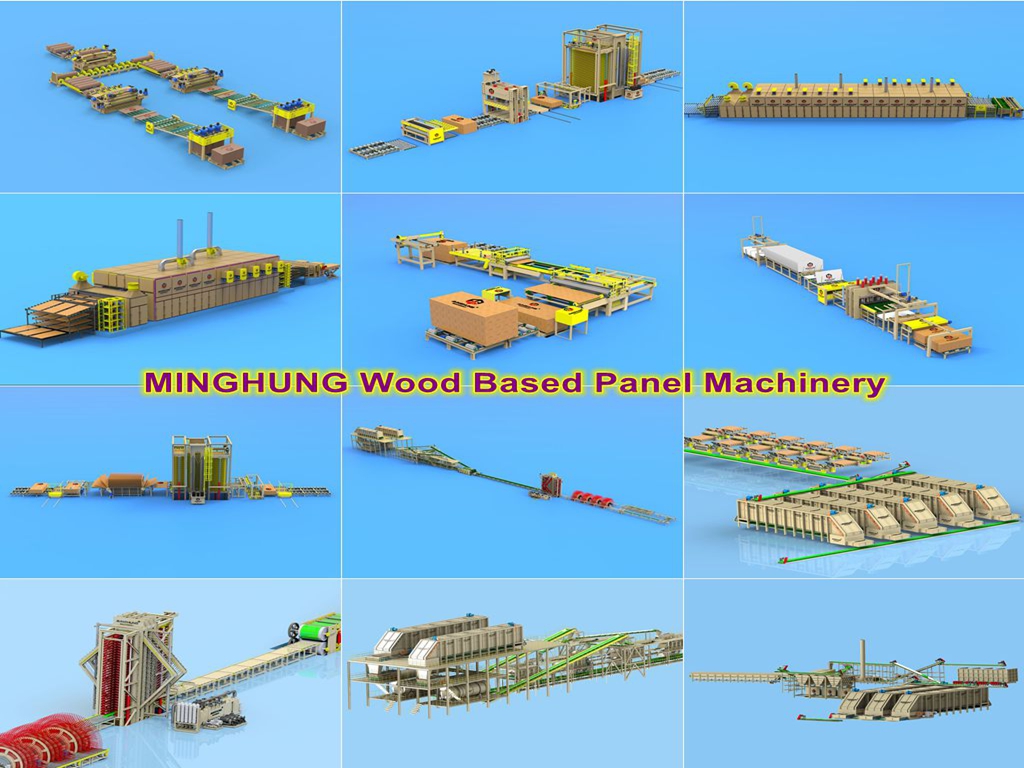
The machinery we have produced not only includes a complete production line for particleboard , but also a full range of production equipment for plywood, density board, and fiberboard.
For more information, welcome contact us, we will reply you quickly and offer working videos with you.
Whatsapp: +8618769900191 +8615589105786 +8618954906501
Email: osbmdfmachinery@gmail.com

What is the Startup & Entry-Level Particleboard Production Line?
This production line is specifically designed for startups and small-scale investors. Its core philosophy is not to pursue ultimate automation and massive capacity, but to achieve "from zero to one, stable production, quick return on investment, and reserved upgrade potential." It serves as a foundational stepping stone to help entrepreneurs enter the industry with minimal risk.
What is the Production Line Specifically Like?
A typical entry-level line can be seen as a "streamlined and efficient version" of a large line. It retains the most essential processes but optimizes costs in automation.
1. Raw Material Section: Focus on Practicality
Crusher/Hammer Mill: Essential equipment for processing wood waste into qualified particles.
Dryer: Usually a small or medium-sized rotary drum dryer to ensure particle moisture content meets standards.
Simple Screening: May use vibrating screens instead of complex air classification for basic surface/core layer separation.
Blender: Core equipment to ensure uniform mixing of resin and particles.
dryer machine
vibrating screen
gluing machine
2. Forming & Pressing Section: The Core
Forming Station: Likely a mechanical former, meeting basic forming needs with sufficient mat quality.
Core Equipment - Multi-Opening Hot Press: This is the signature choice for an entry-level line. Compared to expensive continuous presses, multi-opening presses are low-cost, sturdy, and easy to maintain. Although production is batch-based (pressing one load at a time), it is fully adequate for a startup.
mat forming machine
multilayer hot press
3. Post-Press Section: Manually Assisted Automation
Loading/Unloading System: Works with the multi-opening press to automatically feed and unload the mats; key for safety and efficiency.
Cooling & Cutting: Will have a cooling frame and trim saws, but panel transfer and positioning may rely more on manual labor or simple conveyors.
Sander: Will include a basic sander, though it might not be a full-width calibrating sander, with lower capacity and automation levels.
dryer rack
cross-cut saw
sanding machine
4. Stacking & Packaging Section: Key Area for Cost Control
This is where manual involvement is highest.
Automatic stackers might be omitted, replaced by manual-assisted stacking stations where workers manually place stickers and arrange the stacks.
Packaging might also be done by workers using hand-held stretch wrap machines.
Core Value & Advantages for Startups
1. Very Low Entry Barrier: Enables entrepreneurs with limited capital to enter the particleboard manufacturing sector, turning ideas into reality.
2. Quick Return on Investment (ROI): Due to the small initial investment, the payback period is relatively short once the line runs stably and sales channels are established.
3. High Flexibility: Ideal for handling small-batch, customized orders, allowing quick response to specific local market demands, which is difficult for large factories.
4. Controllable Operating Costs: Energy consumption, maintenance, and labor costs are far lower than those of fully automatic lines.
5. Valuable Learning Platform: Entrepreneurs can deeply understand the entire production process, manage teams, and develop markets by operating this relatively simple line, accumulating invaluable experience for future expansion.
6. Reserved Upgrade Path: Good designs incorporate a modular concept. As the company accumulates capital and market share, it can gradually upgrade – for instance, first adding an automatic stacker, or upgrading the former, eventually replacing the core press when conditions are ripe for a capacity leap.
In summary, the startup and entry-level particleboard production line is not a "watered-down" inferior product, but a "precisely positioned" strategic tool. It deeply understands the core pain points at the startup stage: capital, risk, and flexibility. It does not pursue technical sophistication but focuses on business feasibility and sustainability, serving as a solid runway for entrepreneurs to get their dreams off the ground.

Particleboard Production Process
The particleboard production process is a continuous industrial operation. Its core principle is to mix wood fragments (particles/flakes) with resin adhesive and press them into panels under heat and pressure. It can be divided into the following six core steps:
Step 1: Raw Material Preparation
Wood Preparation: Logs are debarked using a debarker.
Chipping and Flaking: The wood is fed into a chipper to produce small wood chips. These chips are then processed in a flaker to be broken down into finer, specified-sized flakes/particles.
Step 2: Drying and Screening
Drying: The wet particles are fed into a rotary drum dryer, where hot gases reduce their moisture content from high levels (e.g., 30%-50%) to the required range (typically 3%-5%). This is crucial for ensuring the quality of subsequent resin blending and pressing.
Screening: The dried particles are passed through vibrating screens or air classifiers to be separated into fine surface-layer particles and coarse core-layer particles. This is done to achieve a smoother surface and a stronger internal structure in the final board.
Step 3: Resin Blending and Additive Mixing
Resin Application: The screened particles are fed into a ring blender or high-speed mixer.
Mixing: During mixing, resin adhesive (most commonly Urea-Formaldehyde), a waterproofing agent (wax emulsion), and other additives (e.g., hardener) are uniformly sprayed onto the particles and thoroughly blended. This step determines the board's environmental class (e.g., E0, E1) and physical properties (e.g., moisture resistance).
Step 4: Mat Forming and Pre-pressing
Forming: The resinated particles are fed into a forming station. Modern formers typically use mechanical or air-assisted systems, following the "fine-coarse-fine" three-layer or multi-layer principle to spread a uniform, symmetrical mat on a moving steel belt. This ensures uniform density, structural stability, and reduced warping in the finished panel.
Pre-pressing: The loose, formed mat then enters a pre-press, where it is preliminary compacted at room temperature into a "mat band" with sufficient strength for transport and reduced thickness, preparing it for entry into the hot press.
Step 5: Hot Pressing and Curing
Hot Pressing: This is the most critical step in the entire process. The pre-pressed mat is fed into a hot press (modern large-scale lines predominantly use continuous presses, while smaller lines use multi-opening presses).
Curing: Inside the press, the mat is subjected to high temperature (typically 180-220°C) and high pressure. This causes the internal resin to melt and cure rapidly, firmly bonding the loose particles together to form a panel with high strength and specified density.
Step 6: Post-Press Processing
Cooling and Conditioning: The boards exiting the hot press are very hot and must be cooled using a cooler turner. Subsequently, the boards need to rest in a conditioning area for 24-72 hours to release internal stresses, balance moisture content, and stabilize their physical properties.
Cutting and Sanding: The conditioned boards are first trimmed to standard market dimensions (e.g., 1220x2440mm) by cross-cut and trim saws. Then, the boards enter a wide-belt sander for calibrating sanding, which removes the pre-cured surface layer and ensures precise, consistent thickness and a smooth, flat surface, ready for subsequent lamination or direct sale.
(Optional) Automatic Stacking and Packaging: In modern production lines, the sanded finished boards are neatly stacked by automatic stackers, with stickers placed between layers. Finally, the stacks are wrapped in plastic film, reinforced, and labeled by automatic packaging machines, becoming finished products ready for warehousing or shipment.

Key Parameters
1. Product Specifications
Parameter | Typical Range | Explanation |
Annual Capacity | 10,000 - 50,000 cubic meters | Core parameter.Significantly lower than large lines (hundreds of thousands), meeting regional market demand with manageable investment risk. |
Daily Output | Approx. 30 - 150 cubic meters | Calculated based on 300 working days per year. |
Board Density | 600 - 750 kg/cubic meter | Capable of producing medium to high-density boards, covering most furniture and decoration applications. |
Basic Board Size | 1220mm x 2440mm (4' x 8') | The most universal market standard size. |
Board Thickness Range | 8mm - 40mm | Can produce common specifications from thin to thick boards. Manual adjustment is required for thickness changes. |
Operating Schedule | 1-2 shifts | Typically does not require 24/7 continuous operation; production can be scheduled based on orders. |
2. Core Equipment Configuration
Parameter | Typical Configuration | Explanation |
Hot Press Type | Multi-Opening Hot Press | The hallmark of an entry-level line. Investment cost is much lower than a continuous press. Commonly 8-15 openings. |
Press Size | 4' x 8' or 4' x 16' | Matches the target product specifications. |
Forming Method | Mechanical Forming Station | Cost-effective, capable of meeting basic "fine-coarse-fine" three-layer structure requirements. |
Automation Level | Semi-Automatic | Key differentiator. Processes like raw material feeding and mat handling may require manual assistance. Stacking and packaging are primarily manual. |
Control System | PLC + Basic HMI | Enables automated control of core processes, ensuring basic process stability with a low technical barrier for operation. |
3. Cost Estimation
Parameter | Typical Range | Explanation |
Installation & Commissioning | 3 - 6 months | Fast timeline from equipment arrival to first board production, enabling quick market entry. |
Raw Material Requirements | Wood waste (shavings, sawdust, small-diameter logs, etc.) | Widely available, low cost. |
Resin Type | Urea-Formaldehyde (UF) | Most common, lowest cost. More expensive modified resins are needed for E0 grade or moisture-resistant boards. |
The machinery we have produced not only includes a complete production line for particleboard , but also a full range of production equipment for plywood, density board, and fiberboard.
For more information, welcome contact us, we will reply you quickly and offer working videos with you.
Whatsapp: +8618769900191 +8615589105786 +8618954906501
Email: osbmdfmachinery@gmail.com