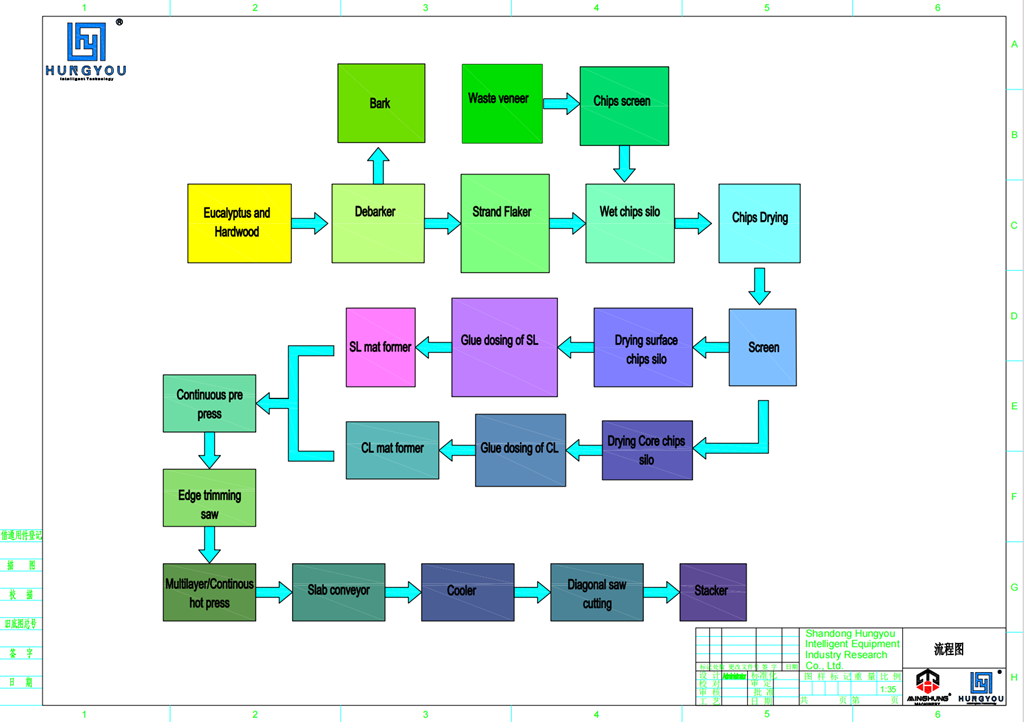
This full small-diameter log OSB production line is specifically designed to utilize low-grade wood resources such as small-diameter logs, thinning wood, and branches, enabling efficient production of high-quality oriented strand board (OSB). The complete line integrates core sections including chipping, strand production, drying, screening, blending, forming, hot pressing and post-treatment. Equipped with an automatic control system, it features low energy consumption and high board yield. This production line solves the challenge of industrial-scale utilization of small-diameter logs, providing customers with a complete solution from raw material to finished OSB panels. It is suitable for new plant construction or upgrading existing lines.
Main Equipment of the Production Line
1. Chipper – Cuts small-diameter logs into wood chips.

2. Ring flaker – Processes wood chips into long, slender strands of specific geometry.

3. Wet strand dryer (drum type) – Reduces strand moisture content to process requirements.

4. Screening and grading equipment – Separates acceptable core/surface strands and fines.

5. Blending system (drum or spray type) – Applies phenolic resin or MDI adhesive to strands.

6. Oriented forming machine – Aligns surface strands along the panel length direction, with core strands cross or randomly oriented.

7. Continuous press or multi-opening press – Consolidates the mat into OSB panels under high temperature and pressure.
8. Post-treatment equipment (cooling turner, edge trimmer, sander) – Panel sizing, sanding and stacking.
OSB stands for Oriented Strand Board. It is a new type of structural engineered wood panel made from small-diameter or fast-growing logs, which are processed into thin, long strands. After drying, blending and oriented forming (surface strands aligned longitudinally, core strands arranged crosswise or randomly), the mat is pressed under high temperature and pressure. OSB offers high strength, excellent dimensional stability, no knots, and good workability, and is widely used in construction, packaging, furniture, and transportation.
What Raw Materials are Considered Small-diameter Logs?
Small-diameter logs (typically ≤12–15 cm in diameter)
Thinning wood (from plantation forest thinning)
Branchwood (trunks and branches)
Fast-growing plantation wood (e.g., poplar, eucalyptus, pine, fir)
Small-diameter plantation logs
Arboricultural pruning residues (processed)
Some low-grade forest by-products
1. Raw material preparation:Debarking and cleaning (optional).
2. Chipping:Cutting raw material into uniform wood chips.
3. Stranding :Chips are processed by a ring flaker into oriented strands (length 30–120mm, thickness 0.5–0.8mm).
4. Drying : Wet strands are dried to 2–5% moisture content in a dryer.
5. Screening / classification :Remove fine powder and oversize strands; separate surface and core material.
6. Blending : Apply adhesive (e.g., phenolic resin PF, isocyanate MDI) and water repellent according to formulation.
7. Oriented forming :Using an oriented forming machine, surface strands are aligned longitudinally, core strands crosswise or randomly, creating a multi-layer mat.
8. Pre-pressing (optional) :Increases mat strength for easier handling.
9. Hot pressing:Mat is consolidated into panels in a continuous or multi-opening press under high temperature (180–220°C) and pressure.
10. Post-treatment:Cooling, edge trimming, sanding, inspection, and packaging.

Building & construction: Flooring, roof sheathing, wall sheathing for wooden houses
Packaging: Heavy machinery crates, export pallets
Furniture: Bed slats, cabinet back panels, sofa lining boards
Transportation: Truck floor panels, container flooring
Decoration: Subflooring, partition walls
Industrial formwork: Concrete pouring forms
Frequently Asked Questions (FAQ)
Q1: What is the minimum capacity of this production line?
A: We offer configurations with annual capacities ranging from 10,000 m³ to 300,000 m³, suitable for small, medium and large factories.
Q2: Must the line use only small-diameter logs? Can conventional logs be mixed in?
A: The line is optimized for small-diameter logs, but it can also handle conventional logs, sawmill residues, etc. The feedstock is flexible.
Q3: How is the strand orientation effect ensured?
A: High-precision mechanical or air-jet oriented forming heads are used, achieving surface orientation degree above 90% and a cross-core structure.
Q4: What adhesive options are available?
A: Phenolic resin (water-resistant), urea-formaldehyde resin (interior grade), or MDI (formaldehyde-free, eco-friendly). We provide corresponding adhesive blending and metering systems.
Q5: Can the line produce overlaid OSB products?
A: The line can be equipped with optional overlaying equipment to produce veneer-overlaid OSB or impregnated paper-finished panels.
Q6: What is the installation and commissioning period?
A: Typically, equipment delivery is completed 6–10 months after contract signing, and on-site installation & commissioning takes 2–3 months, including operator training.
Q7: Is after-sales service provided?
A: Yes, we provide one-year warranty and lifetime technical support. Engineers can be dispatched on-site, and spare parts are supplied.