|
Main Workflow
This production line is a fully automated, continuous industrial manufacturing system. Its core workflow is designed to maximize efficiency and stability, with the following specific steps:
1. Raw Material Preparation and Processing: Wood materials (logs, branches, recycled wood) are chipped, flaked, and ground into qualified particles. They are then screened to remove overly fine or coarse particles, ensuring raw material uniformity.
2. Drying and Classification: The particles are fed into an energy-efficient rotary drum dryer, where moisture content is precisely controlled to meet process requirements (typically 1-3%). Dried particles are then precisely classified via an air classification system.
3. Glue Blending and Mixing: The dried particles are continuously fed into a high-speed blender, where they are uniformly and thoroughly mixed with precisely metered adhesives (e.g., UF resin, MDI), waterproofing agents (wax), hardeners, and other additives.
4. Mat Forming and Pre-pressing: The resinated particles are formed by an advanced mechanical or pneumatic former into a loose, uniform, and symmetric mat on a moving steel belt. This mat is then lightly compressed by a pre-press to increase its strength for easier transport.
5. Hot Pressing (Curing): This is the core forming stage. The mat is fed into a high-precision, high-rigidity multi-opening hot press or a continuous press. Under precisely controlled temperature, pressure, and time profiles, the adhesive rapidly cures, bonding the loose particles into a high-strength board.
6. Cooling and Trimming: The hot-pressed board is evenly cooled via a star-cooler system to release internal stress. It is then trimmed to precise length and its edges are squared off by high-speed cross-cut and trim saws.
7. Sanding and Inspection: The trimmed "green" board undergoes surface finishing through a multi-head heavy-duty calibrating sander to achieve precise thickness and smoothness. Finally, boards are automatically inspected (for thickness, density, defects), graded, packaged, and stacked.

|
List of Main Production Equipment
A complete particleboard production line is a Complex systems engineering,comprising specialized equipment from multiple sections connected in series. Below is a detailed introduction to its main production equipment:
I. Raw Material Preparation Section
1. Debarker: Used to remove bark from logs.

2. Chipper: Processes logs, branches, etc., into specification wood chips.

3. Flaker: Processes wood chips into thin, uniform Processing wood chips (suitable for surface layer material).

4. Grinder / Refiner: Further breaks down large flakes or chip into finer flakes or fibers (suitable for core layer material).
5. Screening Machine: Multi-deck vibration screen or rocking sieve used to classify flakes by size. Oversized flakes are sent back for refining, while fines can be used for energy generation or special products.

II. Drying and Classification Section
6. Rotary Drum Dryer: The most common type, efficiently dries flakes via a rotating drum and a hot medium (hot air or flue gas).

III. Blending and Additive Section
7. Adhesive Preparation System: Includes resin storage, catalyst/mixing tanks, temperature control units.

8. Glue Application System:
Ring Blender: The core equipment. Flakes are thoroughly and uniformly mixed with atomized glue and additives (e.g., wax) inside a high-speed rotating blending drum.
Spraying System: High-precision atomizing nozzles and flow control systems.

IV. Mat Forming and Pre-pressing Section
9. Former:
Pneumatic Former: Uses air flow to distribute flakes onto the forming belt. High forming accuracy, suitable for ultra-thin boards or boards with sky-high surface quality requirements.

10. Pre-press: Applies initial compression to the loose mat to increase strength for transport into the press and remove some air.

V. Hot Pressing (Curing) Section
11. Hot Press (Core of the production line):
Multi-Opening Hot Press: Equipped with a simultaneous closing device and loading/unloading system. Suitable for multi-format, flexible production.

Continuous Press: The mat passes continuously between two heated steel belts where it is pressed and cured. High output, minimal thickness tolerance, low energy consumption. Suitable for large-scale, single-format production.

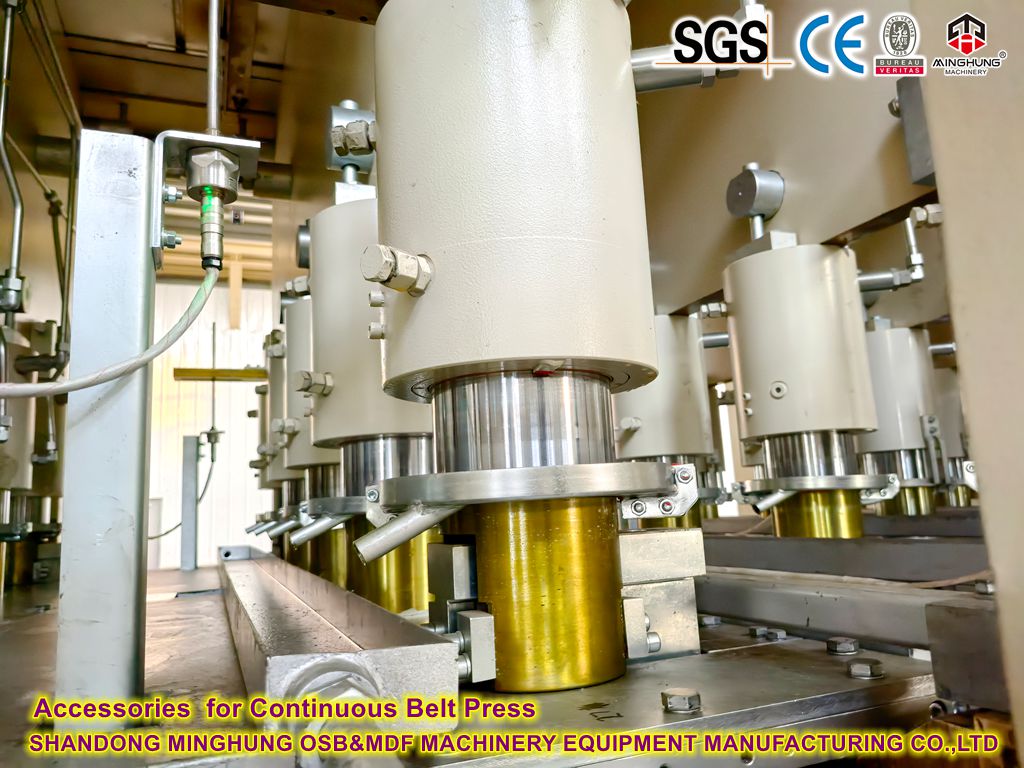
12. Hydraulic System: Provides powerful, stable pressure for the press, including oil pumps, valve blocks, accumulators, etc.
![Continuous Belt Pressing Accessories]()
VI. Post-pressing and Finishing Section
13. Cooler and Board Turner: Ensures uniform and rapid cooling of the hot-pressed board to release stress and prevent warping.

14. Cross-cut and Trim Saw System: Includes intermediate saws, cross-cut saws, and edge trimmers to cut the green board into required final dimensions.

15. Sanding Machine: Multi-head (typically 4-8 heads) wide-belt sander for calibrating thickness and surface finishing of the boards.

VII. Auxiliary and Support Systems
16. Central Control System: PLC and Industrial PC-based automation control system monitoring the entire line.

17. Energy Center: May include boilers, heat recovery units (e.g., for dryer exhaust), providing thermal energy for drying and pressing.

|
Core Advantages of the Production Line
1. Ultimate Reliability, Exceptionally Low Failure Rate: Through military-grade structural design, premium-brand core components, and redundant critical system configurations, it fundamentally eliminates common causes of unplanned downtime. Annual unplanned downtime can be reduced by over 70% compared to conventional lines.
2. Intelligent Health Management for Predictive Maintenance: The built-in sensor network and data analytics platform can provide early warnings for potential failures like bearing wear, hydraulic leaks, or transmission misalignment, shifting maintenance from "reactive firefighting" to "active planning," preventing production interruptions.
3. Significantly Reduced Operational Costs:
Low Maintenance Costs: Exceptional durability reduces spare part replacement frequency; modular design lowers repair complexity and labor costs.
High Energy Efficiency: Efficient press sealing and heat recovery systems, along with waste heat utilization from the dryer, significantly reduce energy consumption per unit of product.
Stable Quality, Low Reject Rate: Precise control throughout the process ensures highly consistent product quality, virtually eliminating large batches of rejects due to equipment fluctuations.
4. Production Flexibility and High Output: Stable performance allows the line to operate long-term at its designed peak speed without needing to slow down to "baby" the equipment. Quick size-changeover capabilities also ensure efficiency in multi-product production.
5. High Return on Investment (ROI): While the initial investment may be slightly higher, the drastically lower costs associated with downtime loss, maintenance, and energy consumption—combined with higher product quality and output—result in a much lower Total Cost of Ownership (TCO) over the line's entire lifecycle compared to standard lines, leading to a shorter payback period.
|
Applications of the Finished Particleboard
The high-quality, uniform, and reliable particleboard produced by this stable line is widely used in the following sectors:
Furniture Manufacturing: A core material for panel furniture, used in cabinets, wardrobes, bookcases, tables, and chairs for carcasses, shelves, and back panels.
Construction and Interior Fit-out: Used for interior partition walls, ceiling panels, flooring underlayment (especially for laminate flooring substrates), door cores, and as a substrate for feature walls in renovations.
Packaging and Logistics Industry: Used to manufacture sturdy and durable packing cases, pallets, and warehouse shelf dividers, providing a cost-effective transportation protection solution.
Commercial Display and Customized Products: Used for shop display cabinets, exhibition stands, office partitions, and the manufacture of specific products like speaker enclosures, toys, and models.
Contact us for a free quote today!
Our contacts:
Whatsapp: +8618769900191 +8615589105786 +8618954906501
Email: osbmdfmachinery@gmail.com