


MH-CHP
MINGHUNG

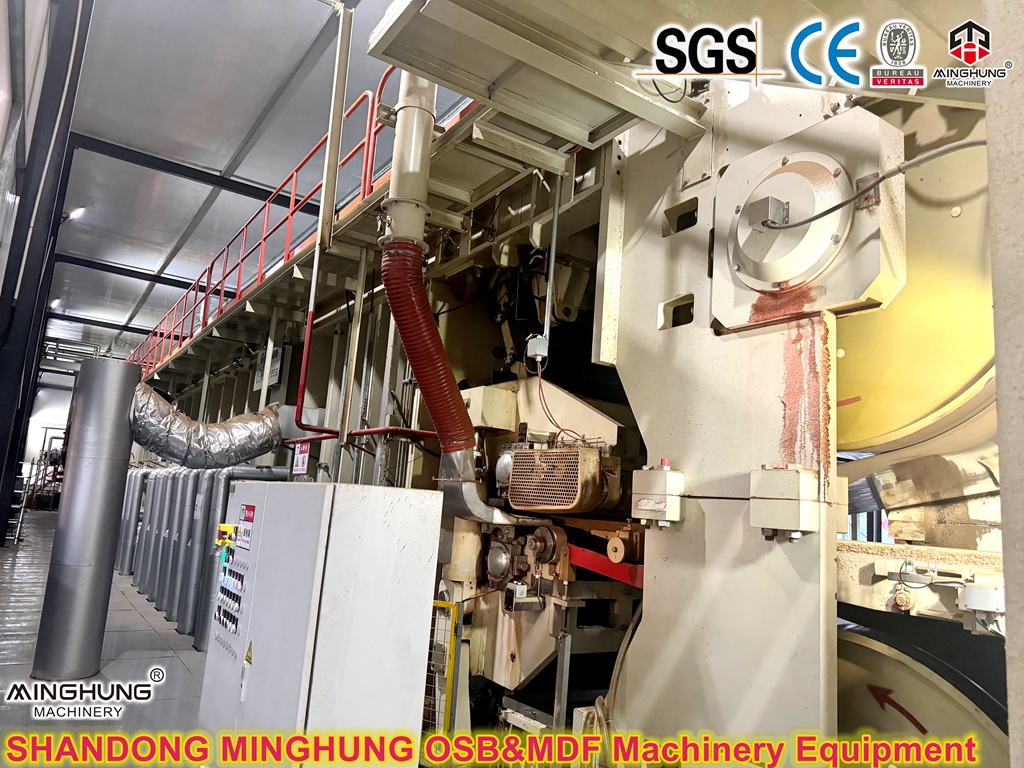
The continuous mat from the forming station first enters a pre-compressor for initial compression (approx. 3:1 ratio) to remove air and increase green strength. The mat is then fed tension-free into the continuous press inlet. The continuous flat press consists of upper and lower endless steel belts and multiple heated platens. Hydraulic cylinders apply continuous, uniform pressure to the mat through the steel belts, while thermal oil circulation transfers heat to the mat, curing the adhesive under high temperature and pressure. The mat runs continuously from the inlet to the outlet, with thickness gradually compressed to the target value. Pressing pressure and temperature profiles are controlled in zones to ensure low internal stress and uniform density distribution. The cured continuous board strip exits the press, passes through a cooling carousel and edge trimming saws, then proceeds to post-processing.
1. Forming System : Mechanical or air-flow spreader for uniform mat formation

2. Pre-Compressor : Initial mat compression for improved conveying stability

3. Continuous Press Main Unit : Includes upper/lower steel belts, heated platens, hydraulic system, heating system

4. Belt Tensioning & Guiding System : Ensures smooth steel belt operation
5. Hydraulic Control System : Precise pressure profile control with zone-specific pressure application

6. Thermal Oil Heating System : Provides stable, uniform heat with zone temperature control
7. Thickness Measurement & Control System : Online continuous monitoring and closed-loop thickness adjustment
8. Cooling Carousel : Cools the board strip to prevent warping

9. Trimming & Cross-Cut Saws : Cuts the continuous strip into standard panel sizes

10. Electrical Automation System : PLC fully integrated automation

Advantage | Description |
CE Certified | Full line complies with EN 16500 standards, exportable to EU and CE-recognized markets |
Continuous Production | No frequent press openings; production efficiency 50%+ higher than multi-opening presses |
High Thickness Accuracy | Online closed-loop thickness control achieves deviation ≤±0.2mm, superior to multi-opening presses |
Low Board Waste | No mat trimming waste; sanding allowance reduced by 30%+ |
Significant Energy Savings | Continuous press consumes 25%-35% less energy per unit product compared to multi-opening presses |
Excellent Surface Quality | Double-sided continuous pressing with no periodic press marks; ready for direct lamination |
Yield Rate 95%+ | Stable process control results in far fewer rejects than batch production |
Special Board Capability | Supports moisture-resistant, fire-retardant, NAF, low-density, and other formulations |
Parameter | Value |
Annual Design Capacity | 30,000 – 400,000 m³/year (optional) |
Production Line Length | 60 – 150 m (depending on configuration) |
Finished Board Width | 1220 / 1830 / 2100 / 2440 / 2700 mm customizable |
Board Thickness Range | 6 – 40 mm |
Max Line Speed | 25 m/min |
Continuous Press Length | 8 – 32 m (depending on capacity) |
Hot Pressing Temperature | 180 – 220 °C (zone adjustable) |
Max Specific Pressure | 50 – 70 kg/cm² |
Thickness Deviation | ≤ ±0.2 mm |
Total Line Power | 800 – 2500 kW (depending on capacity configuration) |
Thermal Oil Flow Rate | 100 – 400 m³/h |
Compressed Air Requirement | 0.6 – 0.8 MPa, dry & oil-free |
Q: What are the main differences between the continuous flat pressing production line and the multi-layer press machine production line?
Answer:A continuous press line runs non-stop : the mat continuously enters the press, offering higher efficiency, better thickness uniformity, lower waste, and reduced energy consumption. A multi-opening press is batch-type : each cycle requires loading, closing, pressing, and unloading - resulting in longer cycle times and poorer thickness control, though initial investment is lower. For projects above 50,000 m³/year, a continuous press offers better overall value.
Q: How long does the steel belt last? Is the replacement cost high?
Answer:Under normal operation and maintenance, steel belt service life is typically 4-6 years. Steel belts are wear parts and replacement cost is significant. However, our design features modular belt joints, reducing replacement time to within 2 days. We also offer belt refurbishment services to extend service life.
Q: Can your company provide overseas installation and commissioning services?
Answer:Yes. We will send 2-4 senior engineers to the customer’s site to supervise installation, guide connection and debugging, conduct no-load and material testing, and provide systematic training for operators and maintenance staff. Service period is typically 3-6 weeks. The customer is responsible for visa, accommodation, and local transportation for the engineers.
Q: What are the requirements for raw materials on the production line?
Answer:Raw materials can include wood particles, sawdust, wood chips, crushed bamboo, straw, and other biomass. Recommended moisture content is 8%-12%, free of metal, stones, and other hard contaminants. We can provide corresponding preparation, drying, and gluing solutions based on the customer’s local raw material characteristics.


