


MH-MDF
MINGHUNG
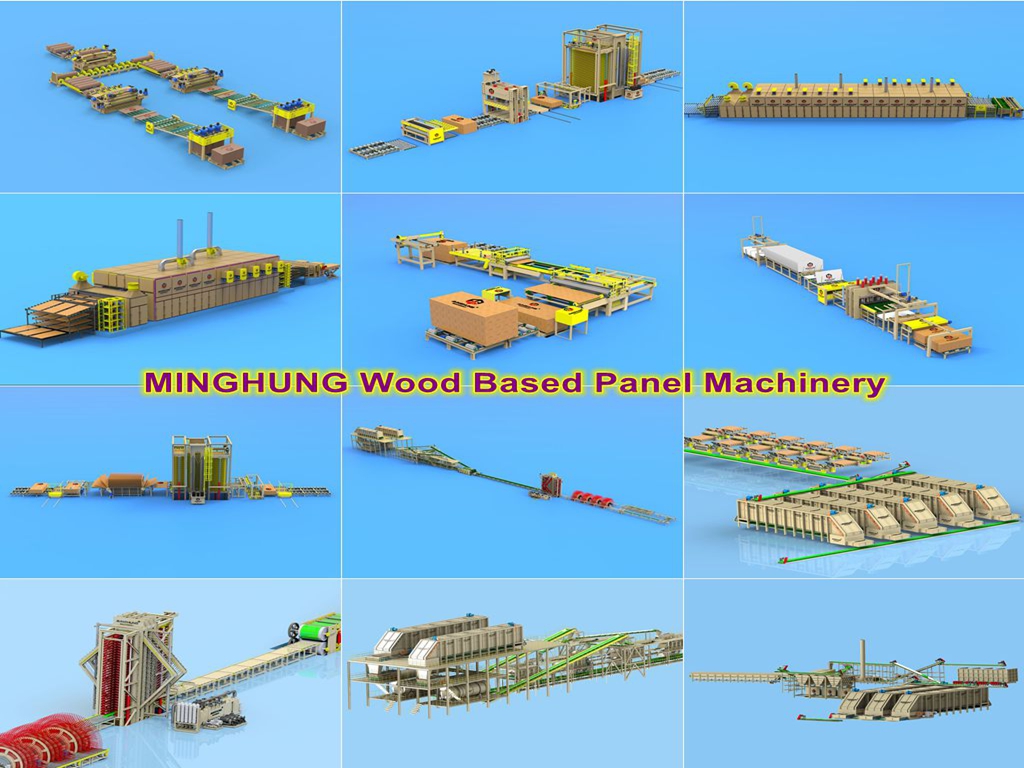
Step 1: Raw Material Preparation & Chipping
Logs or wood processing residues are fed by a chain plate conveyor into a drum or disc chipper, where they are cut into specified wood chips. The chips then pass through a trommel screen to remove oversized chips and fine dust, while a magnetic separator removes metal contaminants, providing clean and uniform raw material for subsequent fiber preparation.
Step 2: Fiber Preparation
Qualified wood chips enter a preheating bin (digester), where they are softened under high-temperature high-pressure steam. The softened chips are then fed into a refiner, where high-speed rotating plates separate them into wood fibers. The fibers pass through a classifier to select those with appropriate length and fineness – thick boards require longer fibers, so more long fibers must be retained to enhance core layer bonding strength.
Step 3: Gluing & Drying
The separated fibers are metered into a gluing system and mixed with a precise ratio of adhesive (UF, MDI, or melamine-modified glue). The glued wet fibers enter a flash tube dryer, where they are instantly dried to target moisture content (typically 8–12%) by high-speed hot air, while carrying away uncured free formaldehyde. The dried fibers are collected by a cyclone separator, ready for mat forming.
Step 4: Thick Mat Forming (Critical Section)
Dried fibers first accumulate in a gravity metering bin, then are fed into a mechanical + air-flow combination former. The former uses multi-layer repeated spreading to build a thick mat up to 100–250mm in height. During forming, an online density detector continuously monitors the cross-sectional density distribution and automatically adjusts the discharge rate of the forming heads. This ensures that the density deviation from the bottom to the top layer of the mat is controlled within ±3% – the key to preventing delamination and soft core in thick boards.
Step 5: Pre-pressing & Hot Pressing
The loose formed mat first enters a pre-press, where low-pressure compression expels air from the mat and increases its strength for transport. The pre-pressed mat is then fed into a continuous press or a multi-opening batch press. For 20–40mm thick boards, the hot pressing system uses a gradient temperature and pressure curve: low pressure for degassing in the initial stage, high pressure and high temperature in the middle stage to fully cure the core layer, and finally pressure release to relieve internal stress. In a continuous press, precise control of the steel belt opening height and line speed ensures that the core layer reaches the full curing temperature (120–140°C) throughout the entire pressing cycle, eliminating delamination and blistering.
Step 6: Raw Board Cooling & Conditioning
The hot-pressed raw board still has a high temperature (approx. 70–90°C). It enters a cooling star turner for forced air or water cooling. After cooling, the raw boards are transferred to an intermediate conditioning warehouse, where they rest for 48–72 hours under normal temperature and pressure. This conditioning process allows moisture redistribution within the board, continued resin cross-linking, and gradual release of internal stress, significantly improving dimensional stability and machinability.
Step 7: Thickness Sanding
After conditioning, the raw boards enter a wide belt sander, typically configured for double-sided or multi-head sanding. Coarse abrasive belts remove the loose surface layer, while fine belts perform precision thickness calibration. An online thickness gauge continuously measures board thickness and automatically adjusts the sanding head pressure, controlling the finished board thickness tolerance to within ±0.3mm, while achieving a smooth and flat surface.
Step 8: Cutting & Stacking
The sanded boards are cut to customer specifications using cross-cut and side-cut saws, trimming the edges and dividing them into standard-sized panels. Finished boards pass through online inspection (thickness, density, appearance). Qualified boards are then stacked by grade using an automatic stacker, wrapped with stretch film or strapped with packing bands, and stored in the warehouse ready for shipment.

Section |
Equipment |
Key Design for Thick Board |
Preparation |
Drum/disc chipper, screener, magnetic separator |
Large feed opening for bulky raw materials |
Fiber refining |
Refiner, preheating bin, fiber classifier |
High-power motor (≥2500kW), long retention steaming, optimized fiber length |
Gluing & drying |
High-precision gluing system, flash tube dryer |
Glue application accuracy ±0.5%, higher resin demand for thick boards |
Forming |
Gravity bin, mechanical+air former, pre-press |
Forming thickness up to 250mm, multi-layer even spreading, density feedback control |
Hot pressing |
Continuous press (or multi-opening press), oil/steam heating |
High opening height (≥80mm), gradient pressure curve, precise core temperature control |
Raw board handling |
Cooling star turner, intermediate storage, cross/side saws |
Large cooling capacity, automated storage scheduling |
Sanding & calibration |
Wide belt sander (double/multi-head), thickness sorter |
Heavy-duty sanding drive, online thickness measurement & automatic compensation |
Automation |
PLC/DCS central control system |
Full process parameter traceability,gang control of press opening & speed |

1. Complete core curing
Gradient hot-pressing process and multi-zone temperature control ensure core layer reaches full curing condition for 20-40mm boards. Internal bond strength ≥1.2 MPa, no delamination or blistering.
2. Uniform density through thickness
Special thick mat forming system combined with online density feedback achieves smooth density transition from surface to core, deviation ≤±3%, preventing edge chipping or soft core during machining.
3. High capacity & low energy
Optimized pressing cycle for thick boards (adjustable continuous press line speed) reduces energy consumption per m³ by 12-18% compared to traditional thick board lines.
4. Excellent flatness
Large-diameter press rollers/platens with precision thickness control achieve board camber ≤1.5mm/m, ready for precision processing without extra straightening.
5. Flexible configuration
The same line can produce both standard MDF (2.5-20mm) and thick MDF (20-40mm) – one machine for multiple applications.
Parameter |
Range / Value |
Annual capacity |
50,000 – 150,000 m³/year |
Board thickness |
20 – 40 mm |
Board width |
1,220 – 2,600 mm |
Board length |
2,440 – 5,100 mm |
Board density |
700 – 880 kg/m³ |
Flatness |
≤1.5 mm/m |
Thickness tolerance |
±0.3 mm |
Adhesive type |
UF, MDI, melamine-modified glue |
Press type |
Continuous press (CPS) or multi-opening press (10-20 openings) |
Application Area |
Specific Uses |
High-load furniture |
Heavy-duty shelving, workbenches, tool cabinets, laboratory countertops |
Construction & decoration |
Stair treads, baseboards, door/window casings, wall panel backing |
Packaging & transport |
Export crates for heavy machinery, reusable pallets, military packaging |
Industrial pads |
Stamping die pads, machinery bases, vibration damping platforms |
Stage & exhibition |
Stage flooring, temporary exhibition structures, mobile platforms |
Vehicle & transportation |
Truck flooring, container liners, RV partition boards |
DIY & processing |
Large worktops, CNC carving blanks, laser cutting backing boards |


Q1: How long does installation and training take?
A: Complete plant installation takes about 4-6 months (including civil work guidance), on-site commissioning and trial production 2-3 months, and operator training 4-6 weeks until independent production.
Q2: Can this line produce both thin and thick boards?
A: Yes. By changing the former metering device and adjusting press parameters, the same line can produce MDF across the full thickness range of 2.5-40mm. However, we recommend customers specify their main thickness range for optimal configuration.
Q3: Are thick MDF boards prone to delamination or blistering?
A: No. Our line is equipped with a gradient pressure/temperature control system and online density monitoring, plus customized adhesive formulations. Delamination and blistering rate can be controlled below 0.5%.
Q4: Are there special raw material requirements for thick MDF?
A: Yes. Thick boards require higher fiber quality. We recommend a mix of softwood and hardwood (e.g., pine + poplar), with fibers ≥2.5mm accounting for >60%. We provide raw material optimization advice.
Our contacts:
Whatsapp: +8618769900191 +8615589105786 +8618954906501
Email: osbmdfmachinery@gmail.com


