


Structural Features
Efficient lifting plate system: Uses combined lifting plates including a leading material guide section, middle lifting section, and rear material leveling section, effectively preventing material adhesion and improving heat exchange efficiency.
Sealing device: Double labyrinth plus fish-scale sealing at inlet and outlet ends, with air leakage rate below 3%.
Transmission mechanism: Large gear ring + riding wheel drive, smooth operation with low noise.
Fire prevention safety design: Equipped with temperature sensors, automatic sprinklers, and explosion-proof doors to prevent spontaneous combustion of wood particles.
Insulation layer: Rock wool insulation wrapped around the drum, reducing heat loss by over 15%.
Working Principle
Wet wood particles are fed by a feeder into an inclined rotating drum, inside which specially designed lifting plates are installed. Hot air (typically 160–220°C) generated by the hot air furnace enters the drum in co-current or counter-current flow with the particles. As the drum rotates, the lifting plates continuously lift and drop the particles, forming a uniform material curtain that fully contacts the hot air for heat exchange, rapidly evaporating moisture. The dried particles are discharged through a discharger, and exhaust gas is treated by a dust removal system before emission.
Main Technical Parameters
Drum diameter: 1.5m – 3.2m
Drum length: 8m – 28m
Processing capacity: 10 – 100 t/h (based on wet material)
Inlet moisture content: 40% – 60%
Outlet moisture content: 2% – 5% (adjustable)
Hot air temperature: 120°C – 250°C
Fuel: biomass pellets, natural gas, coal, heavy oil, etc.
Installed power: 45kW – 315kW
Application Range
Drying of wet wood particles in particleboard, OSB, and LSB production lines
Pre-drying of wood chips in MDF production
Fuel drying for biomass power plants
Drying of raw materials for wood pellet and biomass pellet production
The position of the dryer in the production line
The complete production process of particleboard is as follows: debarking → chipping → drying → screening → mixing with glue → laying down → pre-pressing → hot pressing → cooling → edge sawing → sanding. After drying, the particleboard enters the screening stage, and through the processes of screening, mixing with glue, laying down, hot pressing, etc., it is made into finished board.

Machines Downstream of the Dryer
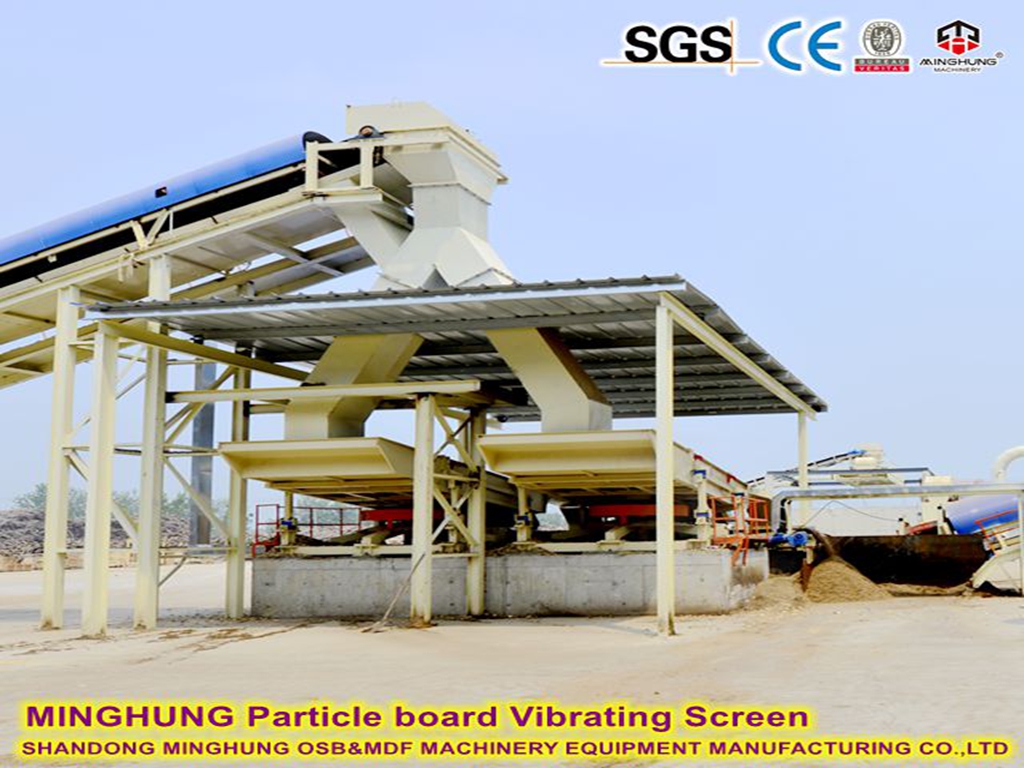
1. Screen (Classifier)
Classifies dried wood particles by size, separating qualified particles, oversized particles, and fine powder. Oversized particles are sent back to the refiner for re-processing, while fine powder can be used as fuel.
Common Types: Vibrating screen, rotary drum screen, air classifier.
Blender (Glue Mixer)
Evenly mixes wood particles with adhesive (urea-formaldehyde resin, phenolic resin, or MDI) to ensure uniform resin coating for subsequent hot pressing.
Common Types: Continuous blender (for large-scale production), batch blender.

Former (Mat Former)
Evenly distributes resin-coated particles onto a conveyor belt to form a mat with specified thickness and density profile. For OSB lines, the former also achieves strand orientation.
Common Types: Airflow former, mechanical graduated former.

Pre-press
Applies initial pressure to the loose mat to expel air, increase density and strength, preventing breakage during transport to the hot press.
Common Types: Continuous pre-press (for continuous lines), intermittent hydraulic pre-press.

Hot Press
Core equipment of particleboard production. Applies high temperature and pressure to cure the adhesive, consolidating loose particles into a dense panel.
Common Types: Continuous press (steel belt type, for large-scale production), multi-opening hot press (multiple panels per cycle), single-opening hot press.
Cooling Carousel (Cooler)
Cools hot panels (exceeding 100°C after pressing) to room temperature, stabilizing internal stress and preventing deformation.

Edge Trimmer (Panel Saw)
Precisely trims rough panels to standard dimensions (e.g., 1220×2440 mm), cutting off irregular edges.
Common Type: Combination of twin circular saws (longitudinal + cross cut).

Sander (Calibrating Machine)
Provides fine surface grinding to eliminate thickness variations and improve surface smoothness for subsequent overlaying or coating.
Common Types: Wide belt sander, thickness calibrating sander.

Our contacts:
Whatsapp: +8618769900191 +8615589105786 +8618954906501
Email: osbmdfmachinery@gmail.com


