MH-MDF
MINGHUNG

Equipment Name | Function Description |
Log Debarker | Removes bark to ensure clean raw material |
Drum Chipper | Chips logs into wood chips |
Chip Vibrating Screen | Screens qualified chips and removes impurities |
Chip Silo | Buffers chips for continuous feeding |
Refiner | Grinds chips into fibers |
Glue Application System | Precisely applies adhesive (UF/MDI) |
Pneumatic Tube Dryer | Dries fibers to target moisture content |
Fiber Silo | Stores dry fibers to balance supply |
Forming Machine | Evenly spreads fibers into a mat |
Mat Pre-press | Pre-compresses mat, expels air and reinforces |
Multi-opening Hot Press (or small continuous press) | Cures and consolidates under high temperature and pressure |
Edge Trimming Saw | Cuts raw board into panels |
Panel Cooling & Tilter | Cools to relieve internal stress |
Stacker | Neatly stacks panels |
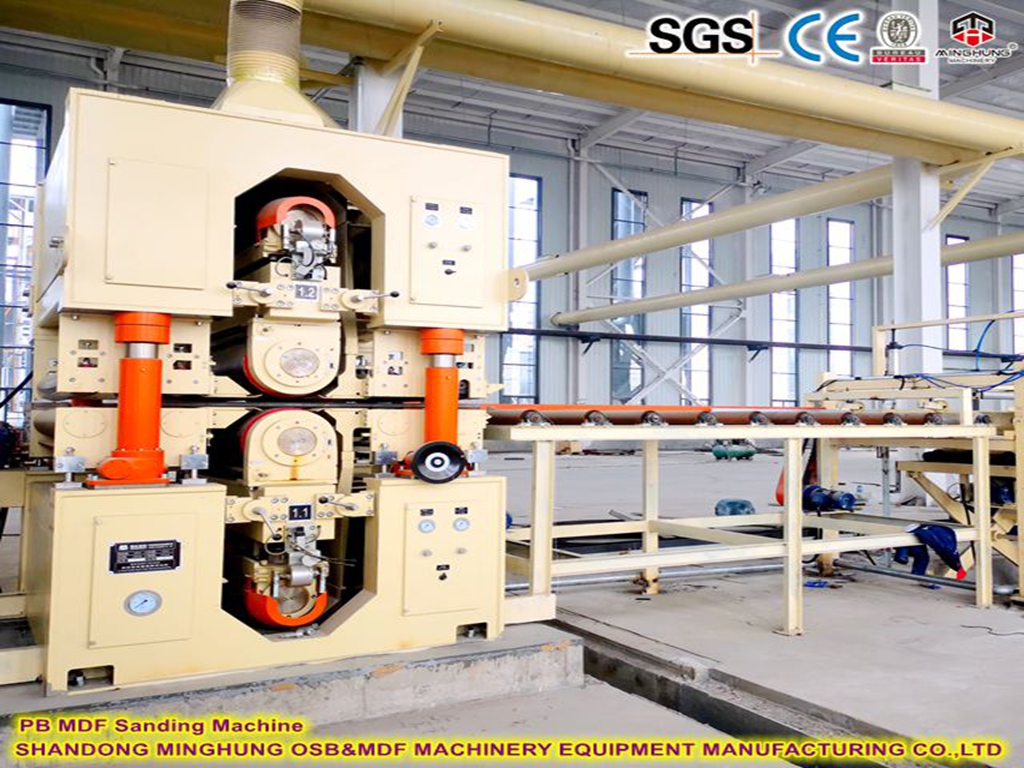
Double-side Thickness Calibration Sander | Thickness calibration and surface finishing |
Longitudinal & Transverse Cutting Saw | Cuts to finished dimensions |
Energy Center (Biomass) | Burns waste for heat supply |
Baghouse Dust Collection System | Collects dust and purifies emissions |
Manual/Semi-automatic Control System | Controls equipment operation |

Overall Process Diagram:
Logs → Debarking → Chipping → Screening → Preheating → Refining → Glue Application → Drying → Fiber Storage → Forming → Pre-pressing → Hot Pressing → Trimming → Cooling/Stacking → Sanding → Cutting → Grading/Packing → Finished Product Warehousing
Step-by-Step Detailed Description:
Step 1: Raw Material Preparation Section
Logs are first debarked by the debarker and then fed into the drum chipper to be cut into uniform wood chips. The chips are screened by a vibrating screen; qualified chips are stored in the silo, while unqualified chips are collected as fuel for the energy center.
Step 2: Fiber Preparation Section
Chips are metered from the silo into the preheating screw, where they are heated and softened by steam, then enter the refiner to be ground into fibers. During grinding, the glue application system adds adhesive to the fibers according to the set ratio. The resinated fibers enter the tube dryer and are rapidly dried by hot air to 8%-12% moisture content, then stored in the fiber silo for later use.
Step 3: Forming and Pre-pressing Section
Fibers are uniformly discharged from the silo to the forming machine, where they are spread into a continuous or intermittent mat. The mat passes through the pre-press to expel air and increase initial strength, preparing it for hot pressing.
Step 4: Hot Pressing Section
The pre-pressed mat is fed into a multi-opening hot press (or small continuous press), where under high temperature (180–220°C) and high pressure, the adhesive cures and fibers bond tightly to form a solid MDF raw board.
Step 5: Post-Treatment Section
The raw board is cut into panels by the edge trimming saw, then enters the cooling and tilter to cool to room temperature, relieving internal stress. Cooled panels are neatly stacked by the stacker and moved to the intermediate buffer area.
Step 6: Sanding and Cutting Section
Buffered panels are fed into a double-side thickness calibration sander for thickness sanding to ensure thickness accuracy and surface flatness. They are then trimmed to final customer-specified dimensions by the longitudinal and transverse cutting saw.
Step 7: Grading and Packing
Finished boards are sorted by quality grade through manual or semi-automatic grading lines, packed, and stored in the finished product warehouse ready for shipment.

1. Low Investment Threshold, Short Payback Period
2. Full-Function, No Compromise on Completeness
3. Compact Layout, Space-Saving
4. Easy Operation, Simple Maintenance
5. Energy-Saving and Eco-Friendly, Turning Waste into Resources
6. Strong Product Versatility
7. Flexible Expansion and Upgrades
Application Field | Specific Use Examples |
Furniture Manufacturing | Panel furniture (wardrobes, bookcases, TV cabinets), kitchen cabinet doors, office desk panels, bed side panels |
Interior Decoration | Decorative wall panels, baseboards, window frames, door frames, ceiling panels |
Flooring Substrate | Laminate flooring substrate, multi-layer solid wood composite flooring core layer |
Packaging Industry | Pallet deck boards, crate side panels, display shelf layers |
Construction Formwork | Concrete pouring formwork, temporary construction partitions |
Door Manufacturing | Interior door core panels, molded door substrates, fire-rated door filler boards |
Automotive Interiors | Car headliner substrates, trunk floor panels, acoustic insulation liners |
Crafts and DIY | Model making, advertising display boards, picture frame backings, DIY craft panels |
Typical Product Specifications (Achievable by the Entry-Level Line)
Thickness: 2 – 25 mm
Width: 1220 – 2440 mm
Length: 1220 – 2440 mm (customizable)
Density: 600 – 850 kg/m³
Adhesive Type: Urea-formaldehyde (UF) or MDI (formaldehyde-free, optional)
We provide comprehensive technical services from factory planning, equipment selection, installation and commissioning to operator training, ensuring customers achieve rapid production start-up and expected economic returns.