


MH-PB
MINGHUNG
Logging residues: branches, treetops, shrubs
Wood processing waste: sawdust, planer shavings, offcuts, sanding dust
Small-diameter logs (≤ 12 cm diameter)
Low-quality wood, insect-damaged wood, used wooden packaging
Allowable bark content up to 15%
Multi-stage impurity removal system: air separation + magnetic separation + screening to remove stones, metals, and dirt
Flexible chipping & flaking: combination of hammer mill and ring flaker, suitable for mixed hardwoods and softwoods
Intelligent drying control: automatically adjusts hot air temperature and residence time based on raw material moisture content
Variable-ratio gluing: adhesive dosage set according to raw material type to save glue
Adaptive hot pressing system: automatically adjusts pressing curve based on mat density profile to prevent blistering or delamination
Produces standard particleboard, moisture-resistant board, and low-density particleboard
Thickness range: 6 mm – 40 mm
Density range: 550 – 800 kg/m³
Formaldehyde grade: E1 / E0 / No-Added-Formaldehyde (optional)
Raw material utilization rate ≥ 92%
Equipment Unit | Function |
Chain conveyor + pit belt | Bulk material receiving |
Disc chipper / hammer mill | Primary crushing |
Ring flaker | Production of qualified particles |
Rotary drum dryer (with dust removal) | Moisture control to 3–5% |
Multi-stage screening system | Separation of surface and core layers |
Refiner (for surface fine particles) | Improved surface quality |
Gluing system (eco-friendly adhesive) | Separate gluing for surface and core layers |
Mechanical/airflow forming machine | Three-layer or gradient mat structure |
Pre-press + continuous hot press | Forming and curing |
Cooling turnover + edge trimmer | Post-treatment |
Double-sided wide belt sander | Thickness tolerance ±0.2 mm |
Automatic stacking & wrapping | Finished product storage |
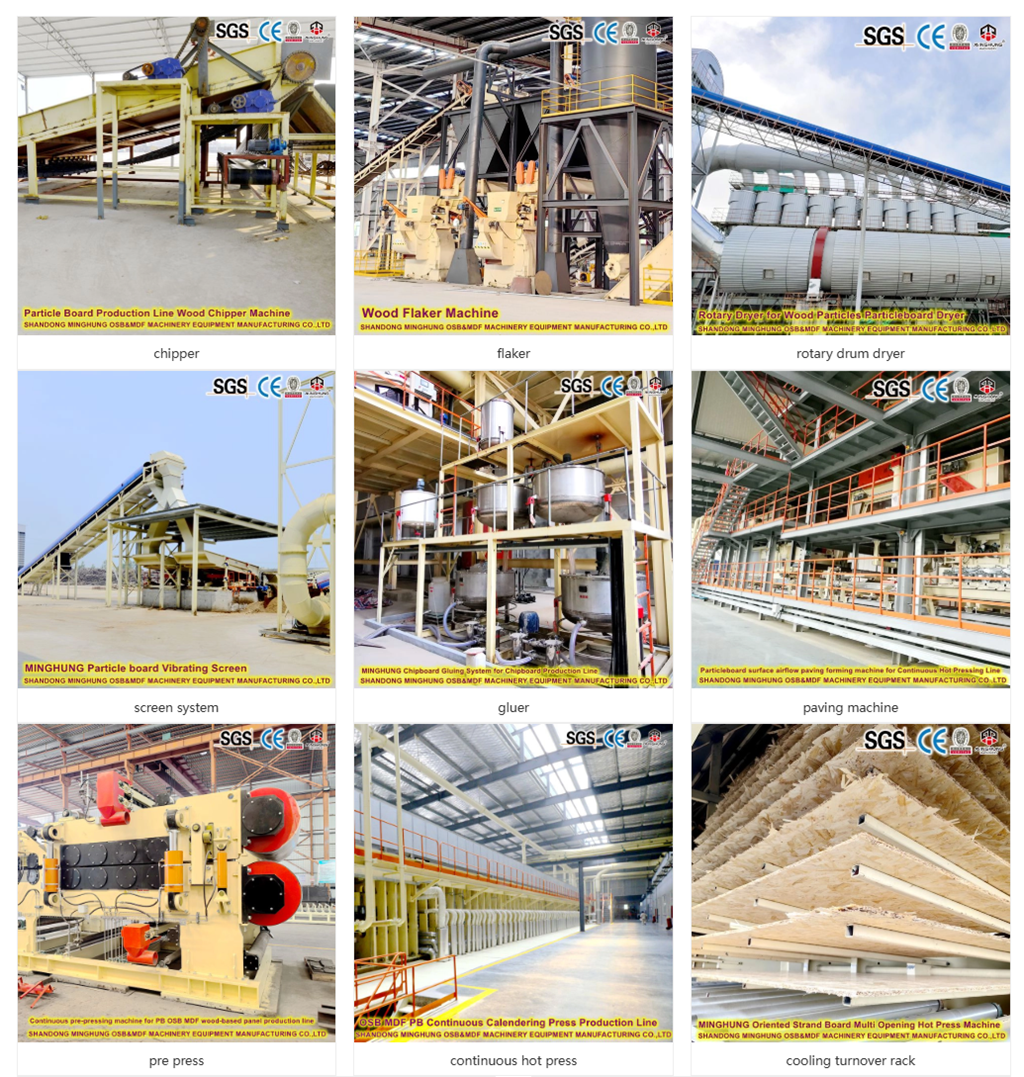
This process is optimized for mixed low-value raw materials including waste wood, small-diameter logs, and branches. It is divided into eight stages:
Stage 1: Raw Material Reception & Pre-treatment
Materials enter via chain conveyor to pit belt.
Magnetic separation (removes nails, iron pieces) and air separation (removes stones, sand, metal).
Large wood (small-diameter logs, branches) goes to disc chipper; fines (sawdust, shavings) proceed directly.
Stage 2: Flaking & Classification
Chips enter ring flaker to produce qualified particles.
Multi-stage screening separates into:
Surface fines (0.2–0.8 mm) → sent to refiner for further refinement
Core coarse particles (0.8–4.0 mm) → direct to drying
Oversized returned for re-flaking; undersized dust used as fuel or filler
Stage 3: Drying
Particles enter rotary drum dryer (hot air or steam heating).
Moisture content reduced from 40–60% to 3–5%.
Drying exhaust treated by cyclone + wet scrubber; fiber particles recovered.
Stage 4: Screening & Refining
Dried particles screened again to ensure surface fines are sufficiently fine.
Surface fines go through refiner for improved panel surface smoothness.
Stage 5: Gluing (Blending)
Low-formaldehyde or NAF adhesives used (e.g., MDI, E0 urea-formaldehyde resin).
Separate gluing for surface and core layers:
Slightly higher glue content for surfaces (better internal bond & surface hardness)
Lower glue content for core (cost saving)
Mixed uniformly via spray nozzles or drum blender.
Stage 6: Forming
Combination of mechanical + air-flow forming.
Three-layer structure formed: fine surface layer + coarse core layer + fine bottom layer (or gradient structure).
Mat pre-compressed by pre-press for strength.
Stage 7: Hot Pressing
Mat enters continuous hot press (or batch multi-opening press).
Temperature: 180–220°C; Pressure: 2.5–4.5 MPa.
Adaptive pressing curve prevents blistering/delamination.
Pressing time: 5–15 seconds/mm thickness.
Stage 8: Post-treatment, Sanding & Packaging
Panels cooled via cooling turnover machine (natural or forced air).
Cross & trim saws for edge trimming to final dimensions.
Double-sided wide belt sander – thickness tolerance ≤ ±0.2 mm.
Thickness & defect inspection (online scanner optional).
Automatic stacking, moisture-proof wrapping, warehousing.

Application Field | Specific Uses |
Furniture Manufacturing | Cabinet sides, backs, shelves; bed rails; office desk substrates; drawer bottoms |
Interior Decoration | Partition wall panels, wardrobe linings, skirting base, ceiling panels |
Packaging Industry | Pallets, support boards, heavy-duty crates, cushion blocks (load-bearing) |
Construction Formwork | Concrete pouring formwork (moisture-resistant grade required) |
Door Industry | Door core boards, door frame fillers, molded door substrates |
Decorative Substrates | Laminating base (melamine, PVC, wood veneer) |
Low-Cost Display Fixtures | Retail displays, temporary shelving, promotional boards |
Circular Economy Products | Pet houses, simple warehouse partitions, agricultural seedling trays |
Transform Your Production Now!
Request Your Customized Quote & Technical Proposal:
Call +86 18769900191, +86 15805496117, +86 18954906501
Get a productivity upgrade plan within 24h


